
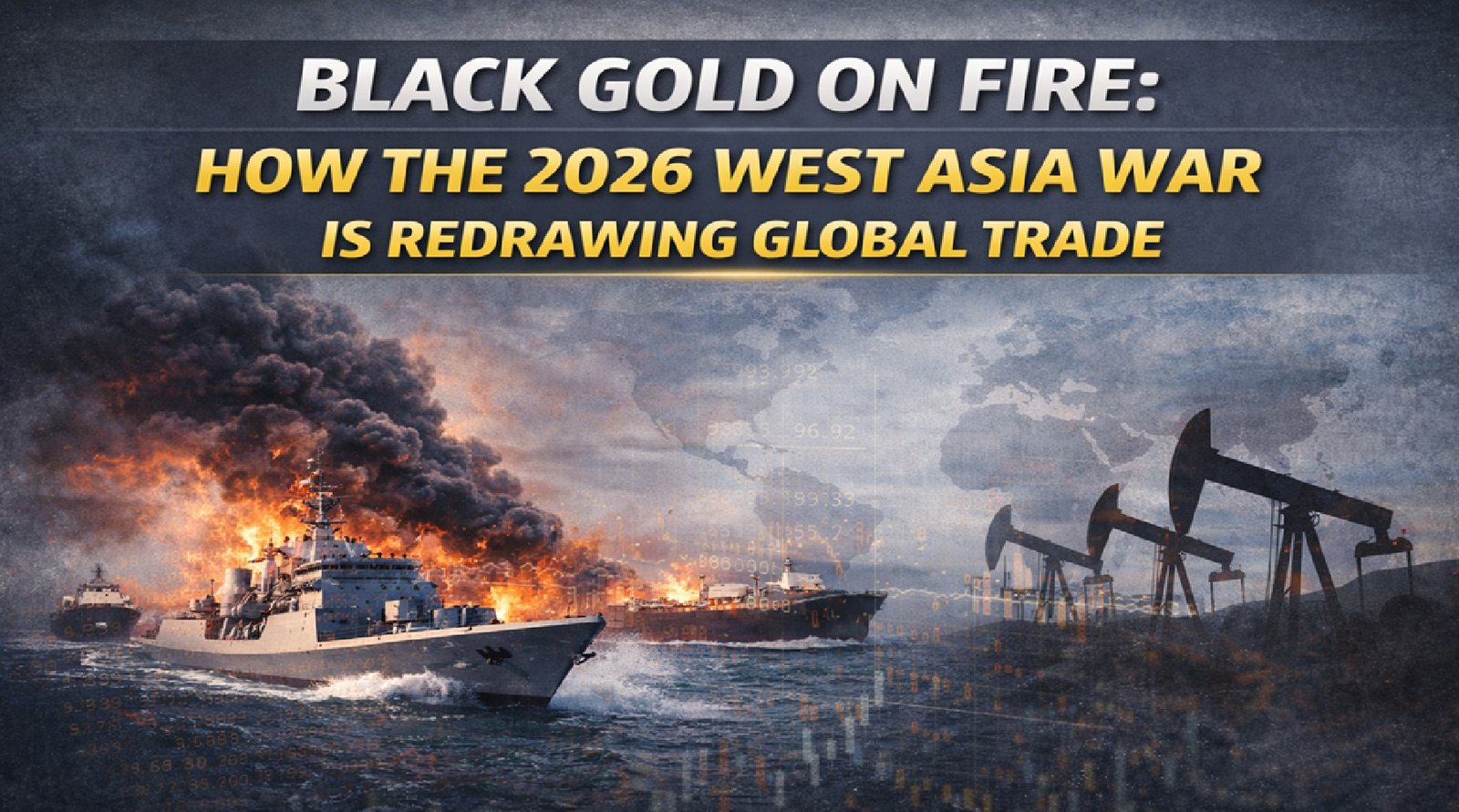
Black Gold on Fire: How the 2026 West Asia War is Redrawing Global Trade
Black Gold on Fire: How the 2026 West Asia War is Redrawing Global Trade
Black Gold on Fire: As global crude oil prices breach the $100 mark and the Indian Rupee hits a record low, we analyze the impact of the US-Israel-Iran war on your pocket and the global economy.
Amit Kaul – For Digital Desk, Bengaluru: March 15, 2026 – The world economy is currently navigating one of its most turbulent periods in modern history. As of March 15, 2026, the ongoing conflict in West Asia has moved beyond a localized regional struggle, evolving into a systemic shock that is fundamentally dismantling and reordering the world’s trade routes. With the “Black Gold”—crude oil—literally and figuratively on fire, the global marketplace is witnessing a shift that will likely define the rest of the decade.
The Chokepoint Crisis: Beyond the Strait of Hormuz
For decades, economists warned of a “doomsday scenario” where the Strait of Hormuz was closed. In March 2026, that scenario has become a partial, terrifying reality. With naval skirmishes and drone activity rendering the passage unsafe for unescorted commercial vessels, the primary artery for 20% of the world’s oil supply has effectively narrowed to a trickle.
https://aamnewsnetwork.com/us-strikes-iran-oil-hub-middle-east-war-2026/
Black Gold on Fire: The Death of ‘Just-in-Time’ Shipping
The war has forced global shipping giants to abandon the Suez Canal and Persian Gulf routes in favor of the long journey around the Cape of Good Hope. This isn’t just a detour; it’s an economic tax. The extra two weeks of travel time have spiked freight rates by 300% since January. For businesses that rely on “just-in-time” inventory, the delay is catastrophic, leading to empty shelves in Europe and manufacturing halts in Southeast Asia.
The Rise of Alternative Land Corridors
In response to the maritime blockade, we are seeing an aggressive acceleration of land-based trade. The International North-South Transport Corridor (INSTC) has seen a massive surge in traffic as traders seek to bypass the volatile waters of the Middle East. Central Asian nations, once on the periphery of global trade, are now becoming central hubs for moving goods between India, Russia, and Europe.
Energy Realignment: The Search for New ‘Safe’ Barrels
With Iranian export hubs like Kharg Island severely damaged and regional tensions at an all-time high, the global energy map is being redrawn. The $100+ per barrel price tag is no longer a temporary spike; it is the new baseline for a world in transition.
Black Gold on Fire: The Shift to the Americas and Africa
Europe, already having decoupled from Russian gas years ago, is now frantically securing long-term contracts with Guyana, Brazil, and Namibia. These emerging energy frontiers are seeing unprecedented investment as the “safe” alternative to the volatility of West Asia. This shift is effectively moving the center of gravity for energy production away from the Persian Gulf and toward the Atlantic Basin.
India’s Strategic Balancing Act
For India, the crisis is a double-edged sword. While the Rupee has hit a record low of ₹92.45, the nation is leveraging its unique diplomatic position. By increasing imports from the Far East and expanding its domestic strategic petroleum reserves, India is attempting to insulate itself from the “Hormuz Hazard.” However, the rising cost of logistics is putting immense pressure on the manufacturing sector, forcing a pivot toward localized supply chains.
The Inflationary Ripple: From Barrels to Bread
The impact of “Black Gold on Fire” isn’t limited to gas stations. The energy crisis is a primary driver of global food and commodity inflation.
Black Gold on Fire: The Fertilizer Connection
West Asia is a major producer of the natural gas required for nitrogen-based fertilizers. As regional production stutters and prices soar, the cost of farming in the Global South has skyrocketed. This is creating a “second-wave” crisis: a global food security threat that could outlast the military conflict itself.
https://digitalamitkaul.online/pakistan-naval-operation-protect-energy-routes-gulf-crisis/
The Accelerant for Green Energy
If there is a silver lining to the 2026 crisis, it is the forced acceleration of the green transition. The “West Asia Tax” has made renewable energy projects—once considered long-term investments—immediately cost-competitive. Solar and wind installations in India and the EU have hit record numbers this quarter as nations realize that energy independence is the only true form of national security.
Author Bio:
Amit Kaul is a seasoned journalist and digital content strategist with over a decade of experience covering business, technology, finance, and digital economy trends. Based in Bengaluru, India, he specializes in producing high-quality, data-driven news articles optimized for global audiences and digital platforms. Amit is passionate about financial inclusion, fintech innovations, and economic developments that shape India and the world. His work has been featured on multiple news portals and Google News platforms, providing readers with timely and reliable insights.

Pingback: Strait of Hormuz Crisis Threatens Global Energy Supply - DNN
Pingback: Middle East War Intensifies as Global Powers Call for De-Escalation - ANN
Pingback: Global Oil Prices Surge as War Disrupts Energy Markets - DNN