
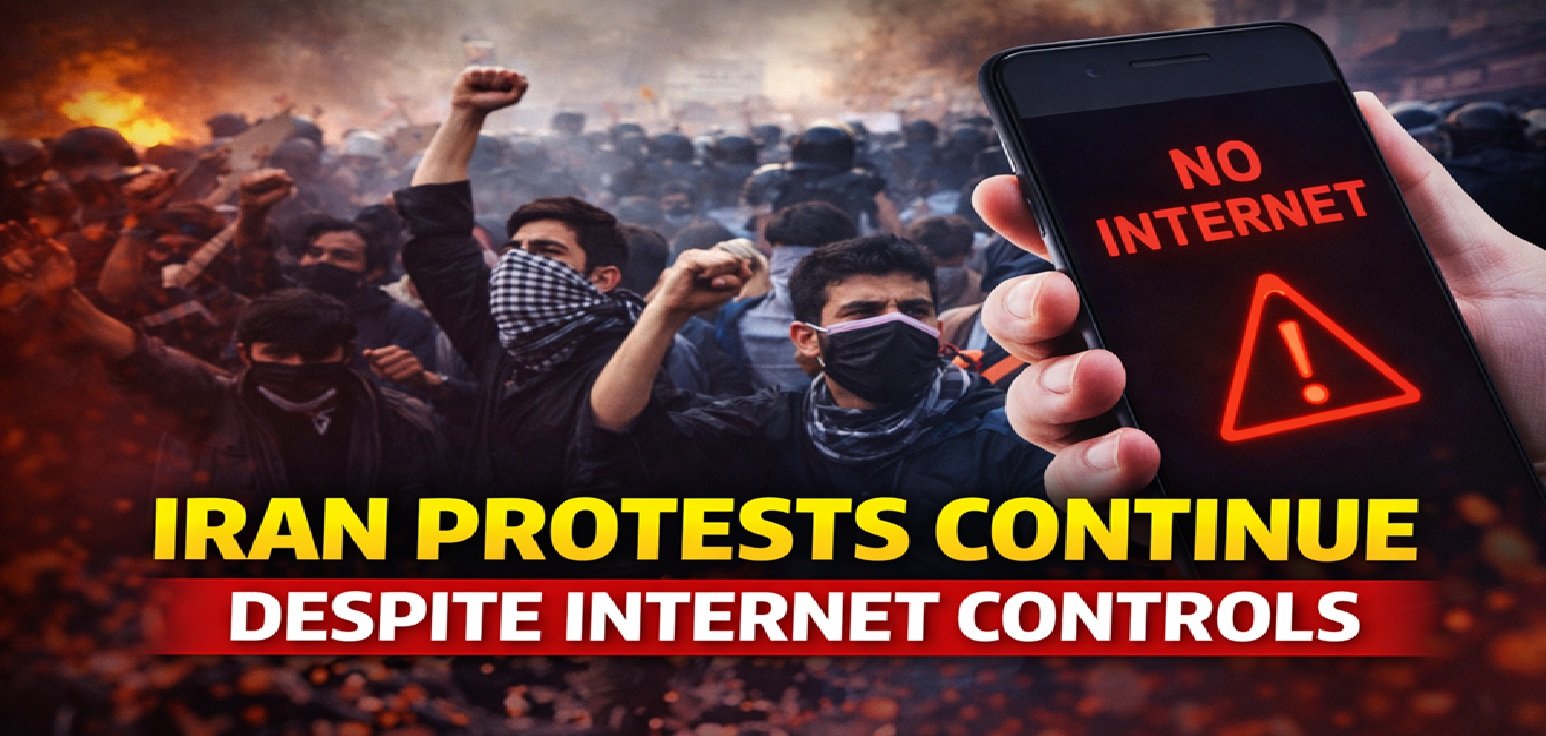
Iran Protests Continue Despite Tightened Internet Controls
Iran Protests Continue Despite Tightened Internet Controls
Iran Protests Continue: Protests continue across major Iranian cities despite tightened internet restrictions and increased security presence. Rights groups report rising arrests as international leaders urge restraint.
Iran Protests Continue Despite Tightened Internet Controls
Amit Kaul – For Digital Desk, Bengaluru: February 13, 2026 – Protests have continued across several major cities in Iran despite intensified internet restrictions and an expanded security presence, signaling persistent public unrest amid mounting political and economic pressures.
Demonstrations were reported in Tehran, Isfahan, Shiraz, Mashhad, and other urban centers this week, according to local sources and international monitoring groups. Protesters gathered in public squares and residential neighborhoods, voicing grievances ranging from economic hardship and inflation to political accountability and social freedoms.
Iran Protests Continue: Communication Restrictions Intensify
Authorities have imposed stricter internet controls in recent days, limiting access to social media platforms, encrypted messaging applications, and certain international websites. Digital rights organizations say the restrictions are aimed at disrupting coordination among demonstrators and curbing the dissemination of protest footage.
https://aamnewsnetwork.com/iran-protests-internet-restrictions-2026/
NetBlocks and other internet monitoring groups reported intermittent connectivity outages and reduced bandwidth speeds in multiple provinces. Such measures have become a recurring feature during periods of unrest, significantly impacting communication for businesses, journalists, and ordinary citizens.
Analysts note that internet shutdowns carry substantial economic consequences, particularly for small enterprises and freelancers reliant on digital platforms. “Communication blackouts affect not only protest logistics but also everyday economic activity,” said a regional technology policy researcher.
Rising Arrests and Security Presence
Human rights organizations report a growing number of detentions in connection with the protests. While official figures have not been released, advocacy groups estimate that dozens — potentially hundreds — of individuals have been arrested since demonstrations escalated.
Security forces, including riot police and plainclothes personnel, have increased patrols in major urban areas. Videos shared on social media before connectivity disruptions showed heavy deployments around key intersections and government buildings.
Iranian authorities have characterized the protests as unlawful gatherings influenced by foreign interference, a claim frequently made during past episodes of unrest. Officials have urged citizens to avoid “illegal assemblies” and warned that participation could result in legal consequences.
Iran Protests Continue: Economic Strain Fuels Discontent
Underlying the protests are deep-rooted economic concerns. Iran continues to grapple with high inflation, currency depreciation, unemployment pressures, and the lingering effects of international sanctions.
Rising costs of essential goods — including food, housing, and fuel — have placed additional strain on households. Economists say purchasing power has eroded significantly in recent years, intensifying public frustration.
Youth unemployment remains a particular flashpoint. With a large percentage of the population under the age of 35, economic stagnation disproportionately affects younger Iranians, many of whom express dissatisfaction with limited job prospects and restricted social mobility.
“Economic grievances often serve as the catalyst for broader political demands,” said a Middle East policy analyst. “When inflation outpaces wages, public frustration can escalate quickly.”
Iran Protests Continue: International Reactions
International leaders have called for restraint and respect for human rights. Several European governments urged Iranian authorities to avoid excessive force and restore open internet access.
The United Nations expressed concern over reports of arrests and communication blackouts, emphasizing the importance of protecting freedom of expression and peaceful assembly. Human rights groups are also calling for transparent investigations into allegations of excessive force.
Diplomatic responses remain measured, reflecting the complex geopolitical landscape surrounding Iran. Ongoing negotiations related to regional security and sanctions continue to shape international engagement.
Historical Context of Unrest
Iran has experienced periodic waves of protest over the past decade, often triggered by economic shocks or political controversies. Demonstrations in previous years have varied in scale and duration, with authorities typically responding through a combination of security measures and temporary policy adjustments.
Observers note that digital platforms play a central role in modern protest movements. The state’s approach to managing online communication has evolved accordingly, with increasing reliance on technical controls to manage information flows.
However, analysts caution that communication restrictions may not fully suppress dissent. “Even when digital access is constrained, public sentiment does not disappear,” said a regional affairs specialist. “In many cases, frustration deepens.”
Outlook: Uncertainty Ahead
The trajectory of the current protests remains uncertain. Much depends on the government’s response in the coming days, including whether internet access is restored and whether dialogue channels are opened.
Markets across the region are monitoring developments closely. Prolonged unrest could have broader economic implications, particularly if disruptions intensify or international tensions escalate.
https://digitalamitkaul.online/global-headlines-february-12-2026-world-politics-business-sports/
For now, demonstrations continue despite tightened controls, reflecting ongoing social and economic pressures within the country. As communication restrictions limit information flow, both domestic observers and the international community are watching events unfold with heightened attention.
The coming weeks will be critical in determining whether the protests dissipate, evolve into sustained unrest, or prompt policy recalibrations.
Author Bio:
Amit Kaul is a seasoned journalist and digital content strategist with over a decade of experience covering business, technology, finance, and digital economy trends. Based in Bengaluru, India, he specializes in producing high-quality, data-driven news articles optimized for global audiences and digital platforms. Amit is passionate about financial inclusion, fintech innovations, and economic developments that shape India and the world. His work has been featured on multiple news portals and Google News platforms, providing readers with timely and reliable insights.


Pingback: US to Deploy Second Aircraft Carrier to Middle East Amid Iran Tensions - DNN
Pingback: UN Chief Backs India to Host Global AI Summit - DNN