
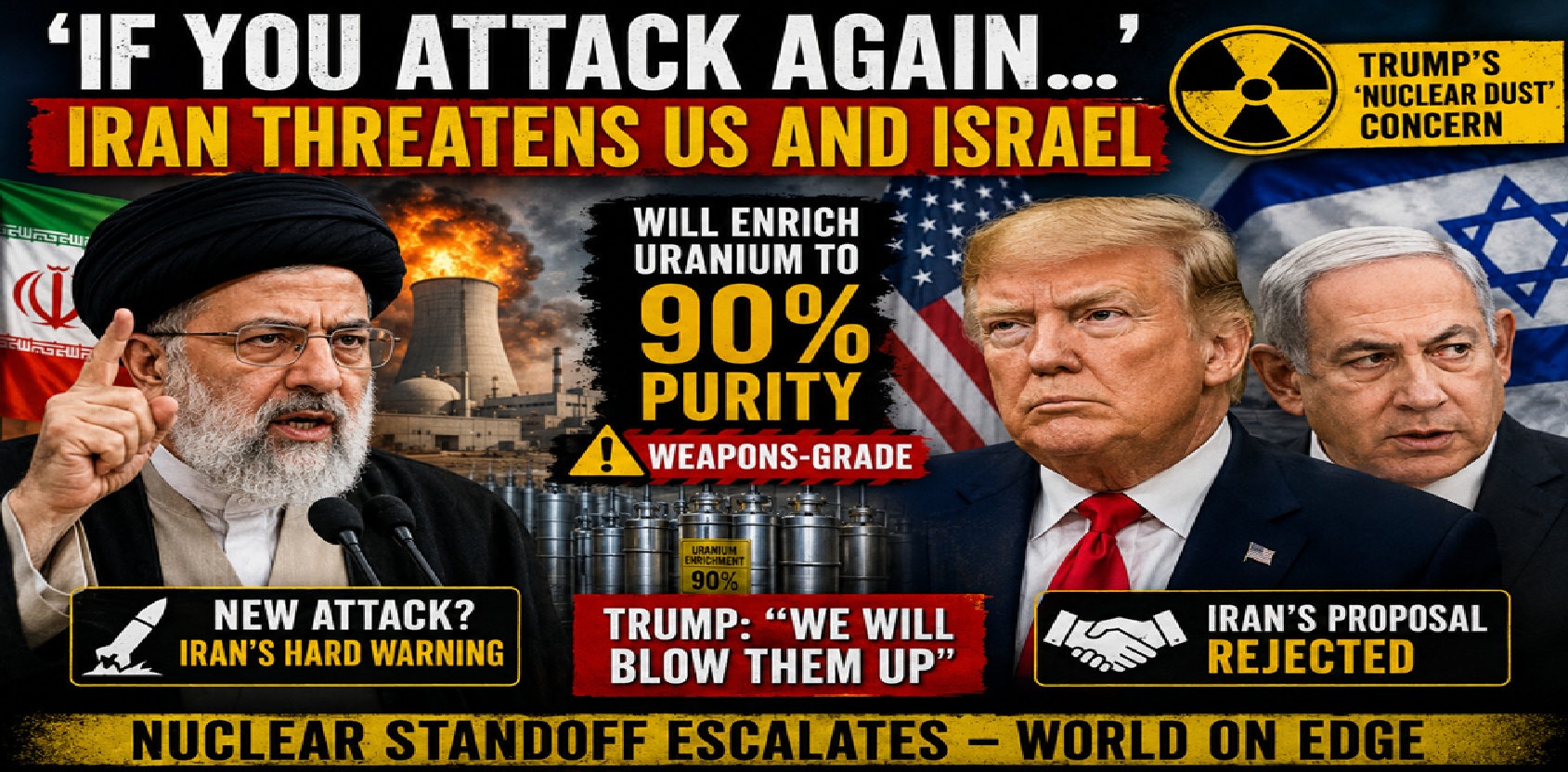
“If You Attack Once More…Iran issues a warning to the United States and Israel as Trump expresses concern over” nuclear dust.
“If You Attack Once More…Iran issues a warning to the United States and Israel as Trump expresses concern over” nuclear dust.
If You Attack Once More: Iran has warned that any fresh attack by the US or Israel could push Tehran to enrich uranium to 90% purity. Here’s an in-depth analysis of the escalating nuclear standoff, Donald Trump’s growing concerns, and the rising risk of a wider Middle East conflict.
Tensions in the Middle East have entered a dangerous new phase after Iran issued a stark warning to the United States and Israel: any future military strike against Tehran could trigger uranium enrichment up to 90 percent purity—a level widely considered weapons-grade.
The threat comes amid mounting reports that Donald Trump is evaluating new military options against Iran as regional ceasefire efforts appear increasingly fragile.
https://digitalamitkaul.online/iran-hormuz-crisis-mojtaba-khamenei-trump-us-tensions-analysis/
The threat exchange has significantly raised concerns that the long-running shadow war between Iran, Israel, and the United States may now be headed toward a direct and potentially catastrophic confrontation based on nuclear capabilities.
“If You Attack Once More”: Iran’s 90 Percent Warning
The latest escalation emerged after Ebrahim Rezaei, spokesperson for Iran’s Parliamentary Commission, publicly suggested that Tehran could dramatically intensify its nuclear program if attacked again.
In a statement posted on X, Rezaei declared that enrichment to 90 percent purity would become one of Iran’s strategic options in the event of renewed military aggression.
That figure is critically significant.
While uranium enriched to lower levels can be used for civilian nuclear energy purposes, enrichment approaching 90 percent is generally associated with weapons-grade capability. Western powers have long argued that such enrichment would drastically shorten Iran’s theoretical “breakout time” to develop a nuclear weapon.
Iran, however, continues to insist that its nuclear activities are defensive and peaceful in nature.
Nevertheless, the latest warning reflects a major shift in tone. Rather than merely denying nuclear weapons ambitions, Tehran is now openly signaling that military pressure could accelerate the very nuclear escalation its adversaries seek to prevent.
Trump’s ‘Nuclear Dust’ Anxiety
Donald Trump has intensified his rhetoric against Iran’s uranium stockpile, reportedly referring to enriched uranium as “nuclear dust” and portraying it as a direct global security threat.
According to reports, Trump has privately and publicly expressed growing frustration over the prolonged conflict dynamics involving Tehran. The standoff has now stretched beyond 70 days, with repeated military, diplomatic, and intelligence confrontations pushing the region closer to instability.
Speaking to reporters earlier this week, Trump issued one of his strongest warnings yet regarding Iran’s nuclear facilities.
“If anyone even goes near that site, we will know, and we will blow them up,” he reportedly said while emphasizing that Iran would never be allowed to obtain nuclear weapons.
The remarks reflect a return to Trump’s long-standing hardline doctrine toward Iran—a strategy centered on maximum pressure, deterrence, and the threat of overwhelming military retaliation.
At the same time, critics warn that such rhetoric could further corner Tehran into adopting more aggressive nuclear posturing.
“If You Attack Once More”: The Collapse of Diplomatic Space
The current crisis also highlights the steady erosion of diplomatic pathways between Washington and Tehran.
Earlier this week, Trump reportedly rejected Iran’s latest counter-proposal aimed at easing tensions. According to media reports, Iran had offered a framework involving the down-blending of a portion of its highly enriched uranium while transferring the remaining stockpile to a third country under controlled conditions.
The proposal, reportedly referenced in a The Wall Street Journal report, appeared designed to reduce immediate escalation risks while preserving Iran’s strategic leverage.
However, Trump dismissed the initiative, suggesting that Middle East ceasefire efforts were now effectively on “life support.”
This rejection significantly narrows the remaining space for negotiated de-escalation.
Why 90 Percent Enrichment Changes Everything
The possibility of Iran enriching uranium to 90 percent purity represents a critical geopolitical threshold.
Such enrichment would significantly change assessments of regional security, even if Tehran did not immediately weaponize the material.
For Israel, which has consistently viewed a nuclear-capable Iran as an existential threat, crossing that threshold could justify preemptive military action.
For the United States, it would create immense political pressure for decisive intervention, particularly under a leadership that has repeatedly vowed to prevent Iran from becoming a nuclear power.
In the meantime, Gulf Arab nations would probably quicken their own strategic security calculations, which would lead to a larger arms race in the region.
Security analysts warn that nuclear escalation in the Middle East would not remain confined to one bilateral rivalry. Instead, it could transform the entire regional balance of power.
“If You Attack Once More”: A Dangerous Cycle of Deterrence
The current confrontation reflects a classic escalation trap.
Israel and the United States contend that military pressure is required to stop Iran from developing nuclear weapons. Iran, on the other hand, argues that growing its nuclear deterrence infrastructure is justified by foreign threats.
As both sides intensify their rhetoric and strategic signaling, the risk of miscalculation rises sharply.
The situation becomes even more dangerous because much of the conflict now operates through ambiguous thresholds—cyberattacks, covert operations, proxy warfare, intelligence sabotage, and strategic threats rather than full-scale declared war.
In such environments, even limited incidents can spiral rapidly into broader confrontation.
The Regional Fallout
The consequences of further escalation would extend far beyond Iran and Israel.
Any significant military confrontation involving Iran has the potential to destabilize Iraq and Syria, interfere with international oil markets, endanger Persian Gulf shipping lanes, and incite reprisals from militias affiliated with Iran throughout the region.
Global powers, including Russia and China, are also closely monitoring developments, particularly given the broader geopolitical competition currently reshaping international alliances.
The nuclear dimension of the crisis makes the situation especially volatile.
Unlike conventional regional conflicts, nuclear brinkmanship introduces long-term strategic uncertainty that affects diplomacy, military planning, and global financial markets simultaneously.
Is the Middle East Approaching a Breaking Point?
For the time being, both sides still mostly rely on strategic messaging, warnings, and deterrence rather than going to full-scale war.
But the language emerging from Tehran and Washington suggests that the margin for diplomatic compromise is shrinking rapidly.
https://aamnewsnetwork.com/israel-secret-military-base-iraq-iran-wsj-report/
Trump’s insistence on stopping nuclear advances at any cost and Iran’s threat to reach 90% enrichment suggest that the conflict may be about to enter its most destructive stage to date.
It’s unclear if diplomacy can still stop escalation.
What is increasingly clear, however, is that the Iran nuclear issue is no longer merely a technical dispute over enrichment percentages—it has become the central fault line of a rapidly intensifying Middle East power struggle.
Author Bio:
Amit Kaul is a seasoned journalist and digital content strategist with over a decade of experience covering business, technology, finance, and digital economy trends. Based in Bengaluru, India, he specializes in producing high-quality, data-driven news articles optimized for global audiences and digital platforms. Amit is passionate about financial inclusion, fintech innovations, and economic developments that shape India and the world. His work has been featured on multiple news portals and Google News platforms, providing readers with timely and reliable insights.



Pingback: Trump’s Global Image Crisis Deepens: U.S. Reputation Falls Behind China and Russia, Global Survey Reveals - DNN
Pingback: Trump-Xi Beijing Summit: Why Donald Trump’s Praise for Xi Jinping Signals a New Phase in U.S.-China Relations - DNN
Pingback: Iran-Kuwait Tensions Escalate After Alleged Attack on Iranian Boat in Persian Gulf - DNN
Pingback: ‘Geography or History?’: Army Chief General Dwivedi Issues Sharp Warning to Pakistan - DNN