Rubio-Jaishankar Press Conference Signals a New Phase in India-US Strategic Ties Amid Visa Debate and Anti-India Concerns
Rubio-Jaishankar Press Conference Signals a New Phase in India-US Strategic Ties Amid Visa Debate and Anti-India Concerns
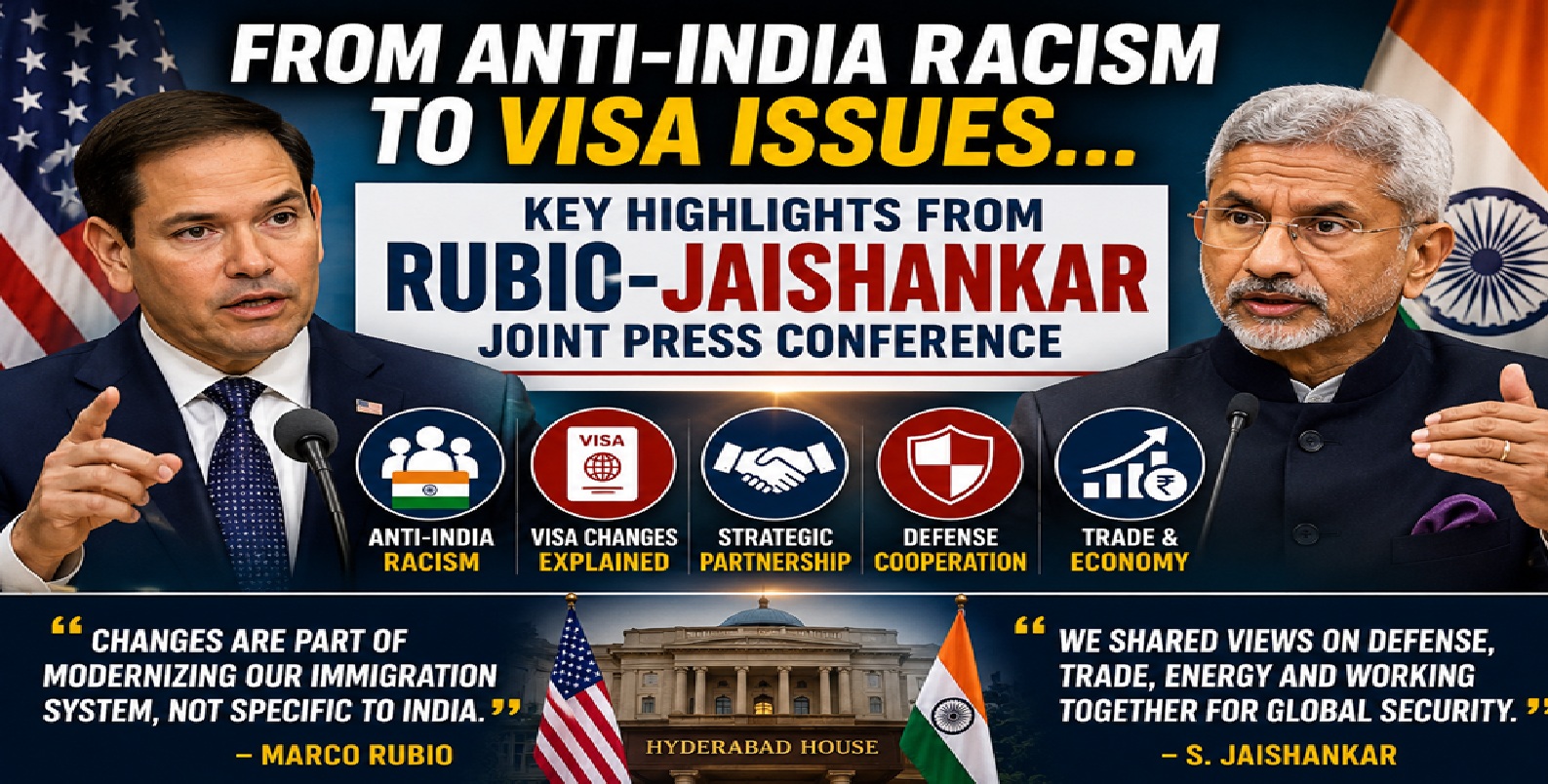
Rubio-Jaishankar Press Conference – US Senator Marco Rubio and External Affairs Minister S. Jaishankar addressed key issues, including India-US strategic ties, H-1B visa reforms, anti-India racism, defense cooperation, trade negotiations, and global security, during a major joint press conference in New Delhi.
India-US Partnership Moves Beyond Diplomacy into Strategic Alignment
Amit Kaul – For Digital Desk, Bengaluru: May 24, 2026 –The joint press conference addressed by US Senator Marco Rubio and India’s External Affairs Minister S. Jaishankar in New Delhi marked more than a routine diplomatic interaction. It reflected the accelerating transformation of India-US relations into a deeply strategic and multi-dimensional partnership shaped by defense, trade, technology, migration, and geopolitical coordination.
Held at Hyderabad House after high-level delegation talks, the event came at a critical geopolitical moment marked by rising tensions in Asia, shifting global supply chains, growing technological competition, and evolving immigration politics in the United States.
Rubio repeatedly stressed that India is no longer viewed merely as an ally or regional partner, but as one of America’s most important strategic partners globally. His remarks underscored Washington’s increasing recognition of India’s role in balancing power dynamics in the Indo-Pacific and contributing to global economic stability.
https://aamnewsnetwork.com/trump-china-visit-no-deal-xi-jinping-trade-talks/
Rubio Defines What a “Strategic Partnership” Really Means
One of the most significant moments during the press conference came when Rubio attempted to define the meaning of a strategic partnership in practical geopolitical terms.
According to Rubio, a strategic partnership exists when the long-term interests of two nations align consistently across multiple sectors and when both countries actively coordinate to address shared challenges.
This distinction matters because India-US relations have historically experienced phases of cooperation mixed with mistrust. During the Cold War era, the two nations often stood on opposite geopolitical poles. However, in recent years, especially after the Quad framework, Indo-Pacific cooperation, and growing China-related concerns, the relationship has evolved dramatically.
Rubio’s comments suggest that Washington now views India not only as a regional power but also as a long-term strategic pillar in Asia.
The emphasis on defense, trade, energy, emerging technologies, and counter-terrorism indicates that the partnership is becoming institutionalized rather than personality-driven or issue-specific.
Rubio-Jaishankar Press Conference – Visa Reforms Become a Sensitive Talking Point
A major focus of the press conference centered on concerns surrounding changes to US immigration policies, particularly regarding J1, F1, and H-1B visas.
For millions of Indians—including students, tech professionals, and entrepreneurs—US immigration reforms remain an emotionally and economically significant issue. India is among the largest contributors to the global technology workforce in the United States, especially in sectors such as software engineering, AI, healthcare, and finance.
Rubio acknowledged Indian contributions directly, noting that Indian companies have invested more than $20 billion into the American economy. This acknowledgment appeared designed to reassure Indian stakeholders worried about tightening immigration policies.
However, Rubio also framed the reforms within America’s domestic political realities.
He emphasized that the ongoing immigration overhaul is not India-specific but part of a broader modernization effort following what he described as a major illegal immigration crisis in the United States over recent years.
This statement reflects the increasingly complex balancing act in American politics:
- Maintaining economic openness
- Addressing domestic border concerns
- Protecting high-skilled immigration channels
- Managing political pressure around migration
Rubio’s remarks indicate that Washington wants to preserve skilled migration from countries like India while simultaneously projecting a tougher overall immigration posture domestically.
For Indian students and professionals, this means opportunities in the US are unlikely to disappear, but bureaucratic scrutiny and procedural changes may continue increasing in the short term.
Rubio Responds to Anti-India Racism and Hate Speech
Another politically sensitive issue raised during the press conference involved racist remarks and anti-India rhetoric targeting Indian-Americans online and in public discourse within the United States.
Rubio strongly condemned such behavior and described the United States as a fundamentally welcoming nation built through immigration.
His response was diplomatically significant because it acknowledged growing concerns among the Indian diaspora regarding online hate campaigns, racial stereotyping, and anti-immigrant rhetoric.
Rubio’s statement that “every country has foolish people” was a deliberate attempt to avoid amplifying fringe voices while still recognizing the seriousness of the issue.
Importantly, he personalized the immigration debate by referencing his own Cuban immigrant family background. This approach reinforced America’s traditional narrative as a nation shaped by migrants while distancing mainstream US policy from extremist rhetoric.
The Indian-American community has grown to be one of the most powerful immigrant groups in the US, especially in the fields of technology, academia, medicine, and entrepreneurship, making the issue politically significant.
Rubio-Jaishankar Press Conference – Jaishankar Highlights Defense and Security Cooperation
During the press conference, Jaishankar outlined how India-US defense cooperation is entering a more operational and technologically advanced phase.
He highlighted the renewal of the 10-year Major Defense Partnership Framework Agreement and the signing of a comprehensive Underwater Domain Awareness roadmap.
These developments are strategically important because maritime security is emerging as one of the central pillars of Indo-US cooperation, especially amid rising Chinese naval activity across the Indo-Pacific.
The reference to “Make in India” in defense manufacturing was equally significant. India increasingly wants foreign defense partnerships to include:
- Technology transfer
- Domestic manufacturing
- Joint production
- Supply chain localization
This reflects New Delhi’s broader effort to reduce long-term dependence on imported military hardware while building indigenous defense capabilities.
Jaishankar’s mention of “lessons learned from recent conflicts” likely alluded to the changing nature of modern warfare, including drone warfare, cyber operations, maritime surveillance, and precision-guided systems.
Trade and Economic Negotiations Gain Momentum
Another major takeaway from the discussions was the push toward an interim bilateral trade agreement.
Both countries appear eager to accelerate economic cooperation amid global supply chain diversification away from overdependence on China.
Trade negotiations between India and the US have historically faced obstacles involving tariffs, market access, digital regulations, agriculture, and intellectual property rights. However, geopolitical realities are now pushing both sides toward faster compromise and coordination.
Jaishankar indicated that the interim agreement could eventually lead to a more comprehensive economic framework first envisioned during Prime Minister Narendra Modi’s US visit in February 2025.
https://digitalamitkaul.online/pm-modi-lavrov-meeting-brics-summit-doval-araghchi-india-russia-iran/
If finalized successfully, such a deal could strengthen cooperation in:
- Semiconductor manufacturing
- Artificial intelligence
- Clean energy
- Pharmaceuticals
- Critical minerals
- Digital infrastructure
Rubio-Jaishankar Press Conference – A Relationship Increasingly Defined by Shared Global Interests
The Rubio-Jaishankar press conference demonstrated that India-US relations are entering a new phase where strategic convergence increasingly outweighs past differences.
While immigration concerns and social tensions remain sensitive topics, both governments appear determined to deepen cooperation across virtually every major geopolitical and economic domain.
The message emerging from New Delhi was clear: India and the United States are no longer simply improving bilateral ties—they are actively building a long-term strategic architecture designed to shape the future balance of power in the 21st century.
Author Bio:
Amit Kaul is a seasoned journalist and digital content strategist with over a decade of experience covering business, technology, finance, and digital economy trends. Based in Bengaluru, India, he specializes in producing high-quality, data-driven news articles optimized for global audiences and digital platforms. Amit is passionate about financial inclusion, fintech innovations, and economic developments that shape India and the world. His work has been featured on multiple news portals and Google News platforms, providing readers with timely and reliable insights.

Pingback: Shots Fired Near White House During Donald Trump’s Iran Talks; Suspect Killed by Police - ANN