
‘Focus Must Be on Indo-Pacific’: Jaishankar Pushes Strategic Quad Vision Amid Rising Regional Tensions
‘Focus Must Be on Indo-Pacific’: Jaishankar Pushes Strategic Quad Vision Amid Rising Regional Tensions
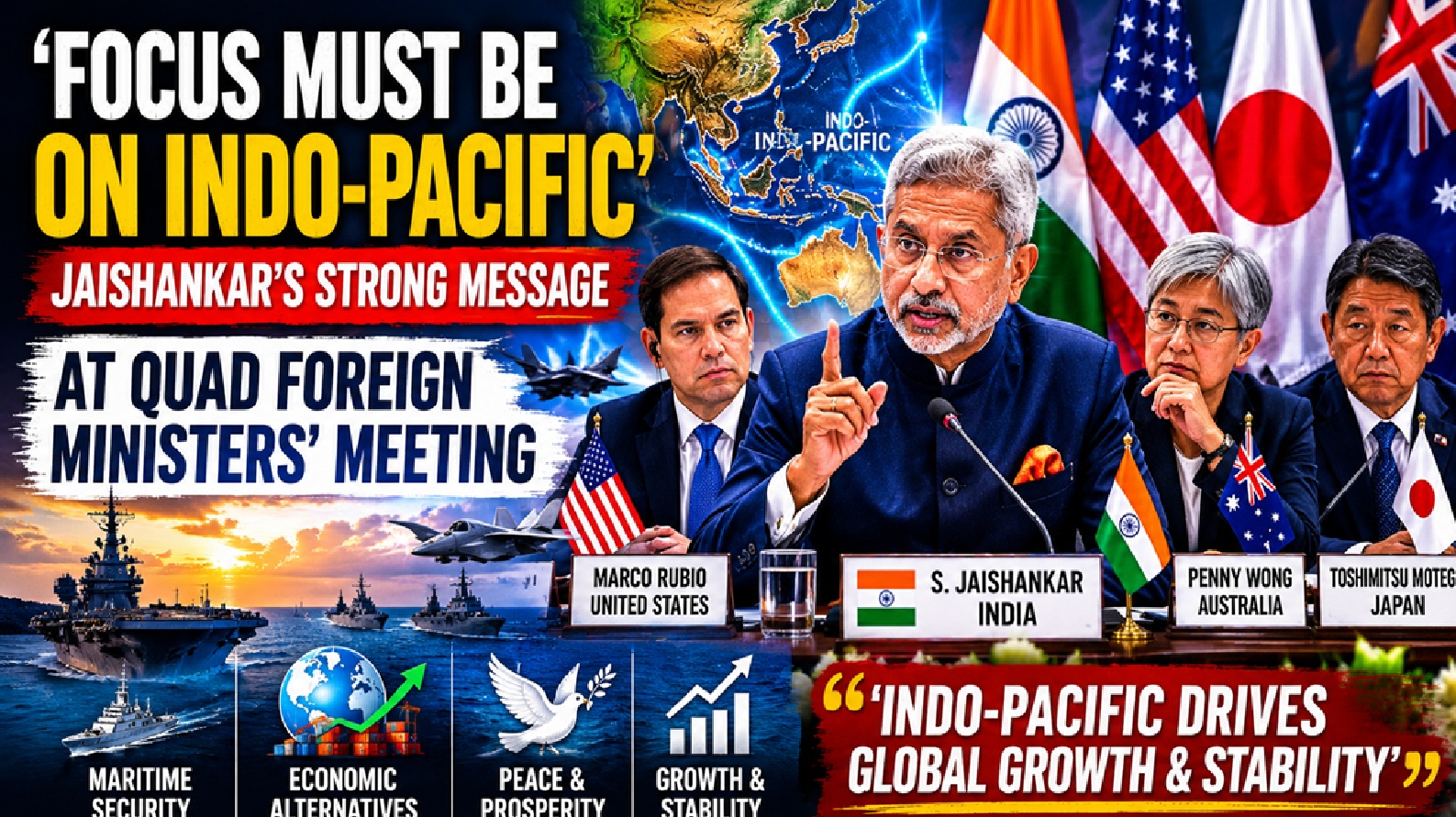
‘Focus Must Be on Indo-Pacific’: External Affairs Minister S. Jaishankar emphasized the importance of the Indo-Pacific region at the Quad Foreign Ministers’ meeting in New Delhi, highlighting maritime security, economic resilience, and strategic cooperation amid concerns over China’s growing influence.
India Reinforces Indo-Pacific Strategy at Key Quad Meeting
Amit Kaul – For Digital Desk, Bengaluru: May 26, 2026 – India has once again placed the Indo-Pacific region at the center of its foreign policy and strategic priorities. Speaking at the Quad Foreign Ministers’ meeting in New Delhi, External Affairs Minister S. Jaishankar stressed that the Indo-Pacific must remain a “driver of global growth and stability,” while calling for stronger maritime security cooperation and credible economic partnerships.
The high-profile diplomatic meeting brought together some of the world’s most influential democracies, including US Secretary of State Marco Rubio, Australian Foreign Minister Penny Wong, and Japanese Foreign Minister Toshimitsu Motegi.
The gathering comes at a critical time when geopolitical competition in the Indo-Pacific is intensifying, particularly amid rising concerns over China’s expanding military and strategic footprint across the region.
https://aamnewsnetwork.com/trump-china-visit-no-deal-xi-jinping-trade-talks/
‘Focus Must Be on Indo-Pacific’: Why the Indo-Pacific Has Become the World’s Strategic Center
One of the world’s most significant geopolitical regions is now the Indo-Pacific area. Stretching from the eastern coast of Africa to the western Pacific Ocean, the area encompasses critical trade routes, strategic sea lanes, energy corridors, and some of the world’s fastest-growing economies.
More than half of global trade flows through Indo-Pacific maritime routes, making regional stability essential for the global economy.
India’s focus on the Indo-Pacific reflects a broader strategic calculation:
- Protecting maritime trade routes
- Countering regional instability
- Ensuring supply chain resilience
- Expanding economic partnerships
- Balancing China’s growing influence
Jaishankar’s remarks indicate that India sees the Quad not merely as a diplomatic grouping but increasingly as a strategic platform aimed at maintaining a rules-based regional order.
Quad’s Expanding Role Beyond Security
Originally viewed primarily as a security-oriented dialogue, the Quad has evolved into a broader strategic coalition involving cooperation in:
- Maritime domain awareness
- Emerging technologies
- Infrastructure development
- Cybersecurity
- Supply chain diversification
- Climate resilience
- Critical minerals and semiconductors
Jaishankar’s call for “credible and transparent partnerships” reflects growing concerns among Quad nations regarding debt-driven infrastructure projects and strategic dependency in the Indo-Pacific.
Analysts believe India is positioning itself as a reliable democratic alternative for regional development cooperation, especially for smaller nations seeking investment without geopolitical pressure.
‘Focus Must Be on Indo-Pacific’: China’s Expanding Presence Looms Over Discussions
Although Jaishankar did not specifically mention China in his opening remarks, the meeting’s backdrop made the underlying geopolitical issues clear.
Beijing has grown dramatically in the last ten years:
- Naval deployments in the South China Sea
- Military exercises near Taiwan
- Strategic port investments across the Indian Ocean
- Belt and Road Initiative (BRI) infrastructure projects
- Influence in Pacific island nations
These developments have alarmed several regional powers, including India, Japan, Australia, and the United States.
For India specifically, concerns over China extend beyond maritime competition. The two nations continue to face unresolved border tensions along the Line of Actual Control (LAC), making broader regional security dynamics highly sensitive for New Delhi.
Security experts argue that the Quad increasingly serves as a balancing framework aimed at preventing unilateral dominance in the Indo-Pacific.
‘Focus Must Be on Indo-Pacific’: Maritime Security Emerges as Core Priority
One of the central themes of Jaishankar’s address was maritime security — an area that has become increasingly critical amid rising tensions in Asian waters.
The Indo-Pacific contains some of the world’s busiest shipping corridors, including the Strait of Malacca and major Indian Ocean routes vital for energy transportation and global commerce.
India has consistently advocated for:
- Freedom of navigation
- Respect for international maritime law
- Peaceful dispute resolution
- Protection of commercial shipping lanes
Recent global developments, including attacks on merchant vessels in strategic waterways and increasing naval competition, have further amplified the importance of coordinated maritime security efforts.
India’s maritime strategy now increasingly combines diplomacy, naval modernization, regional partnerships, and economic outreach.
India’s Leadership Role Within the Quad
Hosting the Quad Foreign Ministers’ meeting in New Delhi highlights India’s growing diplomatic stature within the grouping.
Unlike traditional military alliances, the Quad operates through flexible strategic coordination rather than formal defense commitments. This structure aligns well with India’s longstanding preference for strategic autonomy while still enabling close cooperation with major democracies.
India’s leadership within the Quad is driven by several factors:
- Geographic centrality in the Indian Ocean
- Rapid economic growth
- Expanding naval capabilities
- Diplomatic influence across the Global South
- Increasing alignment with democratic partners
By emphasizing peace, prosperity, and transparency, India is also attempting to position the Quad as a constructive regional initiative rather than an exclusively anti-China bloc.
‘Focus Must Be on Indo-Pacific’: Economic Competition Now as Important as Military Balance
Another important message from Jaishankar’s remarks was the need to create “economic alternatives” in the Indo-Pacific.
This signals a growing recognition that geopolitical influence in the region will not be determined solely through military power but also through infrastructure financing, trade connectivity, technology partnerships, and development assistance.
https://digitalamitkaul.online/pm-modi-lavrov-meeting-brics-summit-doval-araghchi-india-russia-iran/
The Quad nations are increasingly exploring cooperative economic initiatives in areas such as:
- Semiconductor supply chains
- Green energy investments
- Digital infrastructure
- Undersea cable networks
- Critical technology collaboration
India’s role in these initiatives is likely to expand significantly as global companies seek to diversify supply chains away from overdependence on China.
The Bigger Strategic Picture
A larger shift in world geopolitics is reflected in the Quad conference in New Delhi. The Indo-Pacific is no longer merely a regional idea; it is now the main battleground influencing strategic and economic struggle in the twenty-first century.
Jaishankar’s comments highlight India’s conviction that the future of international collaboration, security, and trade will be determined by stability in the Indo-Pacific.
The Quad’s capacity to uphold unity, foster regional confidence, and provide workable strategic alternatives may increasingly influence the balance of power in Asia and beyond as geopolitical tensions grow.
Author Bio:
Amit Kaul is a seasoned journalist and digital content strategist with over a decade of experience covering business, technology, finance, and digital economy trends. Based in Bengaluru, India, he specializes in producing high-quality, data-driven news articles optimized for global audiences and digital platforms. Amit is passionate about financial inclusion, fintech innovations, and economic developments that shape India and the world. His work has been featured on multiple news portals and Google News platforms, providing readers with timely and reliable insights.



Pingback: India-Nepal Border on High Alert: Security Tightens Along Bihar Frontier Amid Crackdown on Illegal Residents in Bengal - ANN