
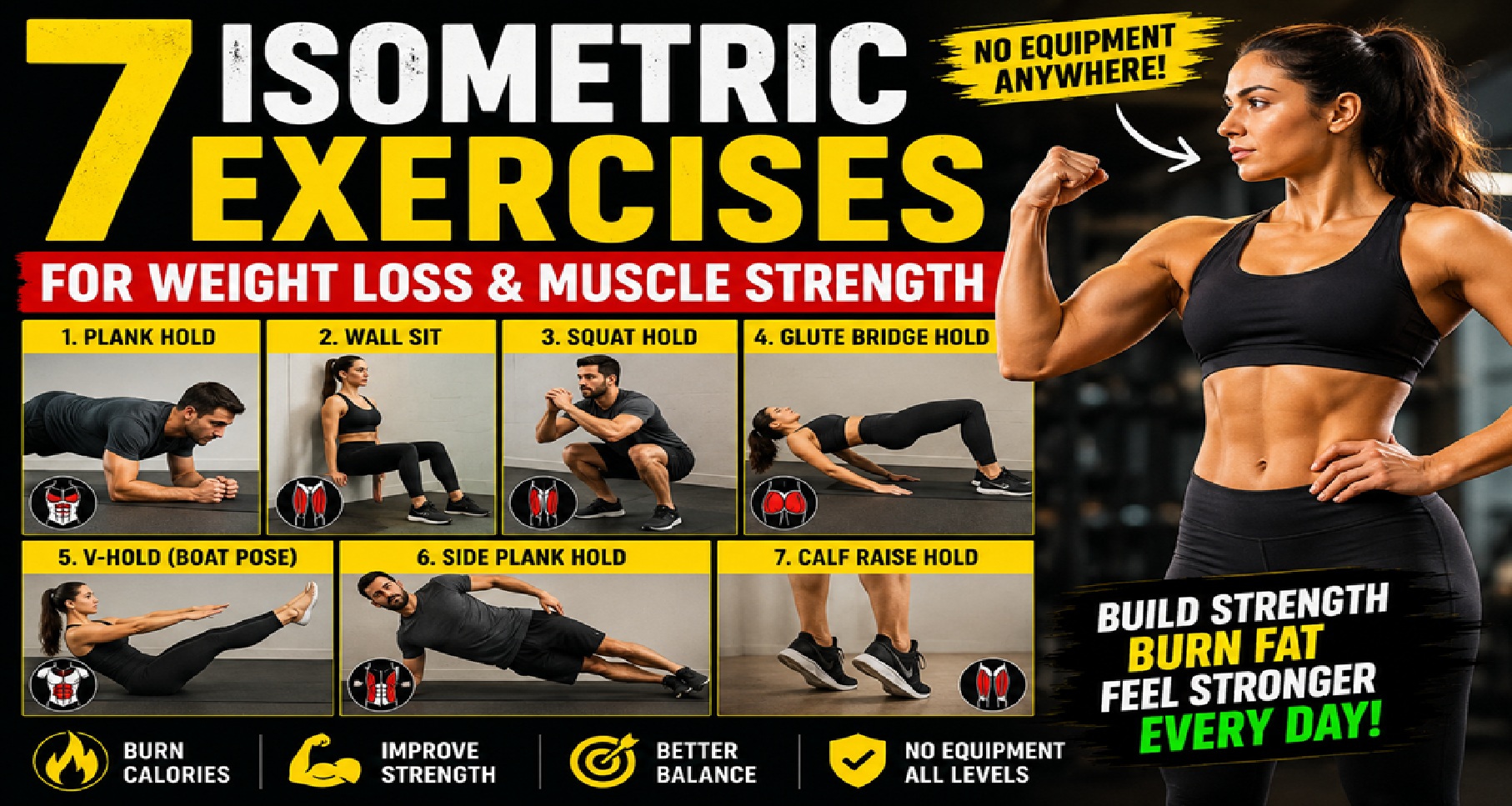
7 Isometric Exercises for Weight Loss and Muscle Strength: Build Power Without Equipment
7 Isometric Exercises for Weight Loss and Muscle Strength: Build Power Without Equipment
Discover the 7 best isometric exercises for weight loss and muscle strength. Learn how plank holds, wall sits, squat holds, and other static exercises improve endurance, burn calories, and build a stronger body without equipment.
7 Isometric Exercises for Weight Loss and Muscle Strength
Amit Kaul – For Digital Desk, Bengaluru: July 24, 2026 – In the world of fitness, faster is not always better. While high-intensity workouts and cardio often steal the spotlight, isometric exercises quietly deliver remarkable results by requiring your muscles to work without visible movement. If you’ve ever struggled to hold a plank for even 30 seconds, you’ve already experienced how powerful these static exercises can be.
Unlike traditional exercises that involve repetitive motions, isometric exercises require you to hold a specific position while keeping your muscles under constant tension. This prolonged muscle engagement builds strength, improves endurance, enhances stability, and contributes to better posture.
Isometric workouts are not a full weight-loss answer, but they can help increase muscular endurance, preserve lean muscle during calorie shortages, and improve general fitness. Combined with a nutritious diet, adequate protein intake, and regular cardiovascular activity, they can support sustainable weight management.
The best part? You do not need a gym membership or expensive equipment. These exercises can be performed virtually anywhere, making them ideal for beginners, busy professionals, older adults, and experienced fitness enthusiasts alike.
https://aamnewsnetwork.com/discover-the-famous-five-pranayams-for-a-healthier-you/
7 Isometric Exercises for Weight Loss and Muscle Strength: Why Are Isometric Exercises So Effective?
During an isometric contraction, muscles produce force without changing length. Because the muscles remain under continuous tension, they recruit multiple muscle fibers simultaneously, leading to improved strength and muscular endurance.
Some major advantages include:
- Builds muscular strength safely
- Improves core stability
- Enhances balance and posture
- Strengthens joints and connective tissues
- Increases muscular endurance
- Supports fat-loss programs when paired with healthy nutrition
- Requires little to no equipment
Fitness experts often recommend adding isometric exercises to regular workout routines because they complement both strength training and cardiovascular exercise.
1. Plank Hold
The plank is one of the most effective full-body isometric exercises available.
How to perform:
Position yourself on your forearms and toes.
Keep your body in a straight line from shoulders to heels.
Tighten your core, glutes, and legs.
Prevent your hips from sagging or lifting excessively.
Hold for 20–60 seconds.
Muscles targeted:
Core
Shoulders
Chest
Lower back
Glutes
Benefits:
Strengthens the entire core
Improves posture
Reduces lower back strain
Enhances stability for everyday movements
2. Wall Sit
The wall sit is an excellent lower-body strength builder.
How to perform:
Stand with your back against a wall.
Slide downward until your knees reach a 90-degree angle.
Keep your feet shoulder-width apart.
Hold the position for 30–60 seconds.
Muscles targeted:
Quadriceps
Hamstrings
Glutes
Calves
Benefits:
Improves leg endurance
Strengthens knee-supporting muscles
Increases lower-body stability
Great for beginners
3. Squat Hold
Unlike regular squats, the squat hold maintains continuous muscle tension.
How to perform:
Stand with feet shoulder-width apart.
Lower into a squat until your thighs are parallel to the ground.
Keep your chest upright.
Hold for 20–45 seconds.
Muscles targeted:
Quadriceps
Glutes
Hamstrings
Core
Benefits:
Builds powerful legs
Improves balance
Enhances hip mobility
Increases muscular endurance
4. Glute Bridge Hold
This exercise strengthens the posterior chain while improving hip stability.
How to perform:
Lie on your back with knees bent.
Raise your hips till you form a straight line with your body.
Squeeze your glutes tightly.
Hold for 30–60 seconds.
Muscles targeted:
Glutes
Hamstrings
Lower back
Core
Benefits:
Improves hip strength
Reduces lower back discomfort
Supports athletic performance
Enhances posture
5. V-Hold (Boat Pose)
Borrowed from yoga, the V-hold is a challenging core exercise.
How to perform:
Sit on the floor.
Lean back slightly.
Lift your legs while remaining balanced on your sitting bones.
Extend your arms forward.
Hold for 20–40 seconds.
Muscles targeted:
Abdominals
Hip flexors
Lower back
Benefits:
Builds core endurance
Improves balance
Enhances body control
Strengthens deep abdominal muscles
6. Side Plank Hold
This version focuses on the muscles responsible for lateral stability.
How to perform:
Lie on one side.
Support yourself on one forearm.
Raise your hips till you form a straight line with your body.
Hold for 20–45 seconds on each side.
Muscles targeted:
Obliques
Core
Shoulders
Glutes
Benefits:
Strengthens side abdominal muscles
Improves spinal stability
Helps reduce muscular imbalances
Supports rotational movements
7. Calf Raise Hold
Often overlooked, strong calves are essential for mobility and balance.
How to perform:
Stand upright.
Rise onto your toes.
Hold the elevated position for 20–45 seconds.
Lower slowly.
Muscles targeted:
Gastrocnemius
Soleus
Ankles
Benefits:
Improves ankle stability
Strengthens calves
Supports walking and running
Enhances balance
Benefits of Isometric Exercises
Adding these static exercises to your weekly routine offers benefits beyond muscle building.
1. Supports Weight Loss
Although isometric exercises burn fewer calories than high-intensity workouts during the exercise itself, they help maintain lean muscle mass. Since muscle tissue burns more energy than fat tissue at rest, preserving muscle can support long-term metabolism. Combined with calorie control and aerobic activity, isometric training contributes to effective weight management.
2. Builds Functional Strength
Holding challenging positions teaches muscles to generate force efficiently, making everyday activities like lifting, climbing stairs, and carrying groceries easier.
3. Improves Joint Stability
Because there is minimal joint movement, isometric exercises are often included in rehabilitation and injury-prevention programs. They strengthen muscles around joints without excessive stress.
4. Enhances Posture
Many isometric movements strengthen the core, back, and hips, helping maintain proper posture during prolonged sitting and standing.
5. Requires No Equipment
One of the biggest advantages is convenience. These exercises require little space and can be performed at home, in the office, or while traveling.
6. Suitable for Most Fitness Levels
Beginners can start with shorter hold times, while advanced individuals can increase duration or add resistance for greater challenge.
Tips to Maximize Results
To get the most from isometric exercises:
- Perform 2–4 sets of each exercise.
- Hold each position for 20–60 seconds, depending on your ability.
- Breathe steadily—avoid holding your breath.
- Focus on proper form over longer durations.
- Pair isometric workouts with strength training, walking, or cycling.
- Consume adequate protein and maintain a balanced diet to support muscle recovery.
Final Thoughts
Isometric exercises prove that effective workouts don’t always require jumping, lifting heavy weights, or spending hours in the gym. By maintaining controlled muscle contractions, these static movements develop strength, endurance, stability, and body awareness while fitting easily into almost any lifestyle.
Whether you’re beginning your fitness journey, returning after an injury, or looking to enhance your existing routine, incorporating plank holds, wall sits, squat holds, glute bridge holds, V-holds, side planks, and calf raise holds can help build a stronger foundation. When combined with balanced nutrition, regular movement, and adequate recovery, these exercises become a practical and sustainable component of a long-term fitness and weight-management plan.
Author Bio:
Amit Kaul is a seasoned journalist and digital content strategist with over a decade of experience covering business, technology, finance, and digital economy trends. Based in Bengaluru, India, he specializes in producing high-quality, data-driven news articles optimized for global audiences and digital platforms. Amit is passionate about financial inclusion, fintech innovations, and economic developments that shape India and the world. His work has been featured on multiple news portals and Google News platforms, providing readers with timely and reliable insights.