
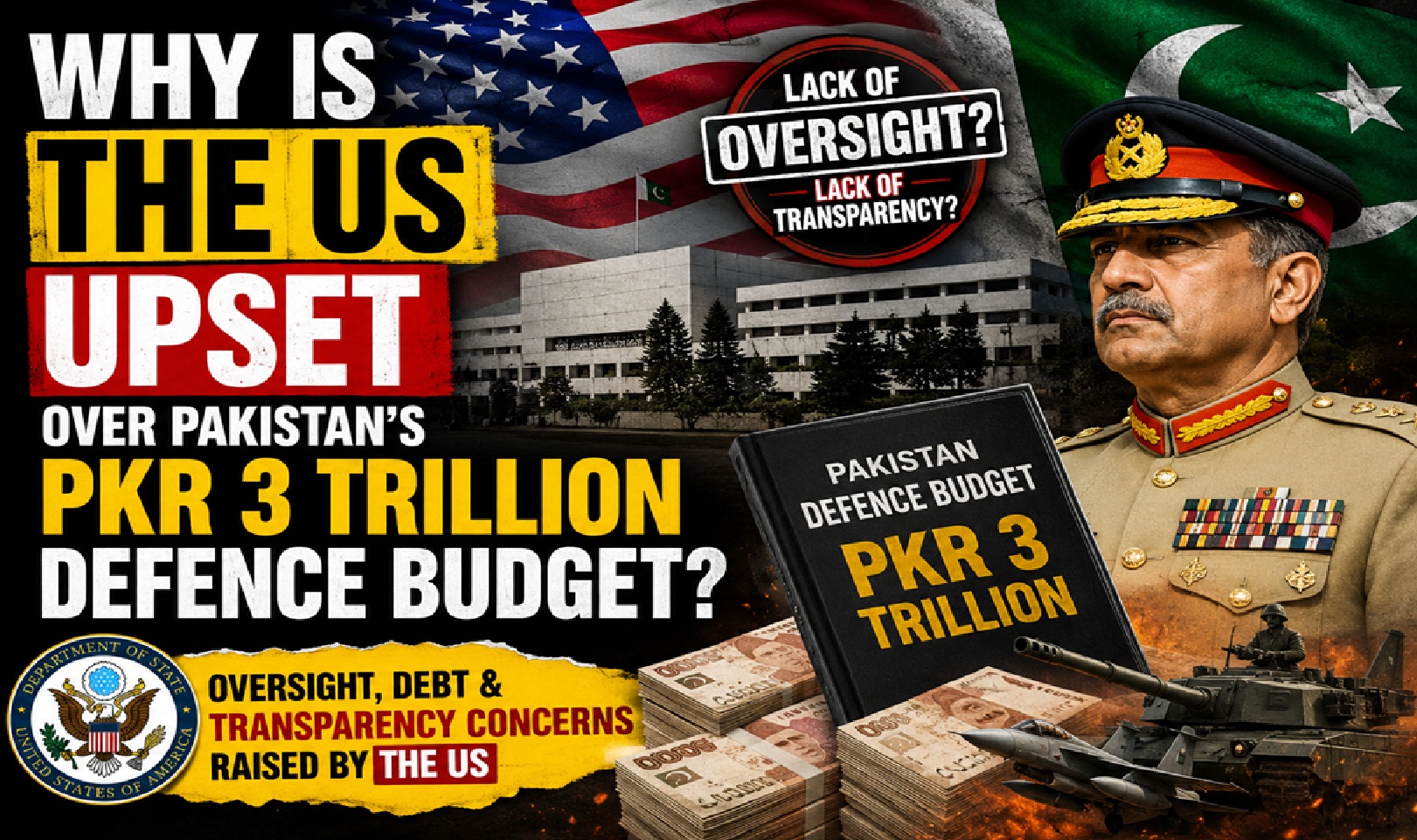
Why Is Pakistan’s Ally, the US, Concerned About Its PKR3 Trillion Defence Budget?
Why Is Pakistan’s Ally, the US, Concerned About Its PKR3 Trillion Defence Budget?
Why Is Pakistan’s Ally, the US, Concerned: Pakistan has raised its FY2026-27 defence allocation to PKR3 trillion. Why is the US demanding greater parliamentary oversight, debt disclosure, and fiscal transparency from its ally?
Amit Kaul – For Digital Desk, Bengaluru: August 13, 2026 – Pakistan’s decision to raise defence spending to PKR3 trillion for fiscal year 2026-27 has drawn renewed attention in Washington—but the US concern is not simply about the size of Pakistan’s military budget. The deeper issue is how defence and intelligence spending is scrutinised, disclosed and integrated into the country’s broader public-finance system.
A factual clarification is important at the outset. The US assessment cited in the ANI report is the US State Department’s 2025 Fiscal Transparency Report, released in September 2025—not a 2026 report. The report’s recommendations are now receiving renewed attention because Pakistan’s defence allocation has subsequently climbed to PKR3 trillion for FY2026-27.
That distinction matters because the US criticism predates the latest defence-budget increase. In other words, Washington’s concern is not necessarily a direct reaction to the PKR3 trillion figure. Rather, the latest spending increase makes an existing transparency debate more consequential.
https://aamnewsnetwork.com/china-india-partners-not-rivals-beijing-strategic-message-analysis/
The real US concern: accountability, not merely defence spending
Pakistan’s military occupies an unusually powerful position within the country’s political and institutional structure. Against that backdrop, the State Department’s central recommendation is significant: military and intelligence budgets should be subject to adequate parliamentary or civilian public oversight.
The US report found that Pakistan’s enacted budget and year-end financial report were widely accessible, including online. However, it concluded that military and intelligence spending did not receive adequate parliamentary or civilian scrutiny. It also recommended that Pakistan publish its executive budget proposal within a reasonable period and provide more detailed information about government debt, including obligations associated with major state-owned enterprises.
This is therefore a governance issue as much as a defence issue.
For Washington, a government can maintain a large defence establishment while still satisfying transparency expectations—provided legislators and appropriate civilian institutions have meaningful mechanisms to examine expenditure, assess priorities and audit public money.
Why Is Pakistan’s Ally, the US, Concerned: Why PKR3 trillion makes the debate more important
Pakistan’s FY2026-27 budget proposed PKR3 trillion for defence services, a 17.65% increase from the previous year’s original allocation of PKR2.55 trillion. According to Dawn, the allocation represents about 2.08% of projected GDP and nearly 16% of total federal expenditure.
The increase comes amid a difficult security environment, including tensions with India, security concerns along the Afghanistan border and continuing militant violence inside Pakistan.
From Islamabad’s perspective, the argument is straightforward: a deteriorating security environment requires greater military preparedness.
But the fiscal question is more complicated.
Pakistan is simultaneously trying to maintain fiscal discipline, raise revenues, manage debt and satisfy the conditions associated with its economic stabilisation programme. The federal government projects total expenditure of about PKR18.77 trillion, while debt servicing alone is expected to exceed PKR8 trillion.
That creates an obvious policy dilemma: how much of the country’s limited fiscal space can be devoted to defence while still financing development, education, healthcare, infrastructure and economic growth?
The more defence spending increases, the more important transparent parliamentary scrutiny becomes.
The headline PKR3 trillion does not tell the whole story
Another important issue is that Pakistan’s headline defence allocation does not necessarily represent the complete cost of maintaining the military establishment.
For FY2026-27, military pensions are being accounted for separately. The government has allocated approximately PKR822 billion for military pensions, while defence-related civil works are projected at around PKR363.16 billion. Defence administration has also received a separate allocation.
There is another important transparency issue: Dawn reported that major military imports and defence acquisitions have generally been financed outside the primary defence-budget head and remain undisclosed. The published budget also does not disclose expenditure associated with Pakistan’s nuclear weapons programme, which is financed through separate classified arrangements.
This is precisely where the debate moves beyond the simple question of whether PKR3 trillion is “too much.”
The more relevant question is: What is the full fiscal cost of Pakistan’s defence and security establishment, and how much of it can citizens and elected representatives independently scrutinise?
Why Is Pakistan’s Ally, the US, Concerned: The debt-transparency problem
Washington’s concerns extend beyond military spending.
The State Department also criticised Pakistan for providing only limited publicly available information about its debt obligations, including liabilities associated with major state-owned enterprises. It called for detailed disclosure of government debt and state-owned enterprise obligations.
This matters because state-owned enterprises can carry substantial financial obligations that ultimately create risks for the government and taxpayers.
If such liabilities are not clearly consolidated or disclosed, headline government-debt figures may not provide the public, investors or legislators with a complete picture of fiscal exposure.
For a country dependent on external financing and working to restore investor confidence, transparency is therefore not merely an accounting principle. It can have direct implications for borrowing costs, investor sentiment and international credibility.
Why Is Pakistan’s Ally, the US, Concerned: Why Washington is raising the issue now
The US has significant strategic interests in Pakistan, particularly regarding regional security, counterterrorism, Afghanistan and South Asian stability. The relationship has historically involved periods of close security cooperation as well as considerable disagreements.
That makes the fiscal-transparency criticism noteworthy.
Washington is effectively saying that strategic partnership does not eliminate the need for institutional accountability.
The US assessment is also consistent with the broader principles embedded in its fiscal-transparency framework, which evaluates whether governments make budget information public, disclose debt obligations, maintain credible auditing mechanisms and provide appropriate oversight of sensitive spending. US legislation requires the State Department to publish annual fiscal-transparency assessments and recommendations.
So the criticism should not automatically be interpreted as Washington opposing Pakistan’s defence requirements.
Rather, the US position is that security spending should be accompanied by stronger civilian and legislative controls.
Why Is Pakistan’s Ally, the US, Concerned: Pakistan’s audit system gets US recognition
Interestingly, the State Department’s assessment was not entirely negative.
The report recognised several areas where Pakistan’s fiscal framework performs relatively well. It noted that the enacted budget and end-of-year reports were accessible to the public and that budget information was generally reliable and subject to audit.
Washington also praised Pakistan’s supreme audit institution, saying its independence met international standards and that audit findings were published within a reasonable timeframe.
That creates an important distinction: Pakistan does have functioning elements of fiscal accountability; the US criticism is focused on specific gaps, particularly sensitive security expenditure, debt disclosure and budget timing.
The larger strategic question
Pakistan’s PKR3 trillion defence allocation must ultimately be viewed through two competing realities.
The first is national security. Pakistan faces genuine security challenges, and its government argues that increased military expenditure is necessary to maintain deterrence and operational readiness.
The second is economic sustainability. Pakistan is dealing with high debt-servicing requirements, limited fiscal space, and pressure to increase development spending and strengthen the productive economy.
The development side of the equation is particularly relevant. The federal Public Sector Development Programme has been allocated about PKR 1 trillion, considerably below the defence allocation.
This does not mean defence spending and development spending are necessarily substitutes. A secure state requires credible defence capabilities. But long-term national power also depends on economic growth, human capital, infrastructure and institutional strength.
Bottom line
The United States is not simply “upset” because Pakistan is spending PKR3 trillion on defence. The more precise interpretation is that Washington is concerned about the transparency and civilian accountability surrounding Pakistan’s military and intelligence expenditure.
The latest defence increase makes that concern more significant because the fiscal stakes are rising.
For Pakistan, the challenge is to demonstrate that national-security expenditure can coexist with robust parliamentary oversight, comprehensive debt disclosure and timely budget publication.
https://digitalamitkaul.online/us-israel-espionage-threat-critical-trump-netanyahu-rift-analysis/
For Washington, stronger transparency would improve fiscal governance and potentially investor confidence while reinforcing civilian institutional authority.
Ultimately, the debate is not just about how much Pakistan spends on defence. It is about who can see the spending, who can question it, who can audit it—and whether the public can understand the full financial cost of the country’s security architecture.
That is why the PKR3 trillion defence budget has become a much bigger story than a single budgetary number.
Author Bio:
Amit Kaul is a seasoned journalist and digital content strategist with over a decade of experience covering business, technology, finance, and digital economy trends. Based in Bengaluru, India, he specializes in producing high-quality, data-driven news articles optimized for global audiences and digital platforms. Amit is passionate about financial inclusion, fintech innovations, and economic developments that shape India and the world. His work has been featured on multiple news portals and Google News platforms, providing readers with timely and reliable insights.



Pingback: Tension Building in the Arctic? Why Putin’s NATO Warning Raises a Bigger Security Question - ANN
Pingback: Now or Never: Will the US-Iran Conflict End? Trump–Khamenei 14-Point Draft Signals Historic Turning Point - ANN
Pingback: Why Saudi Crown Prince Mohammed bin Salman Reportedly Blocked Netanyahu’s Plan to Join the War Against the Houthis - DNN