
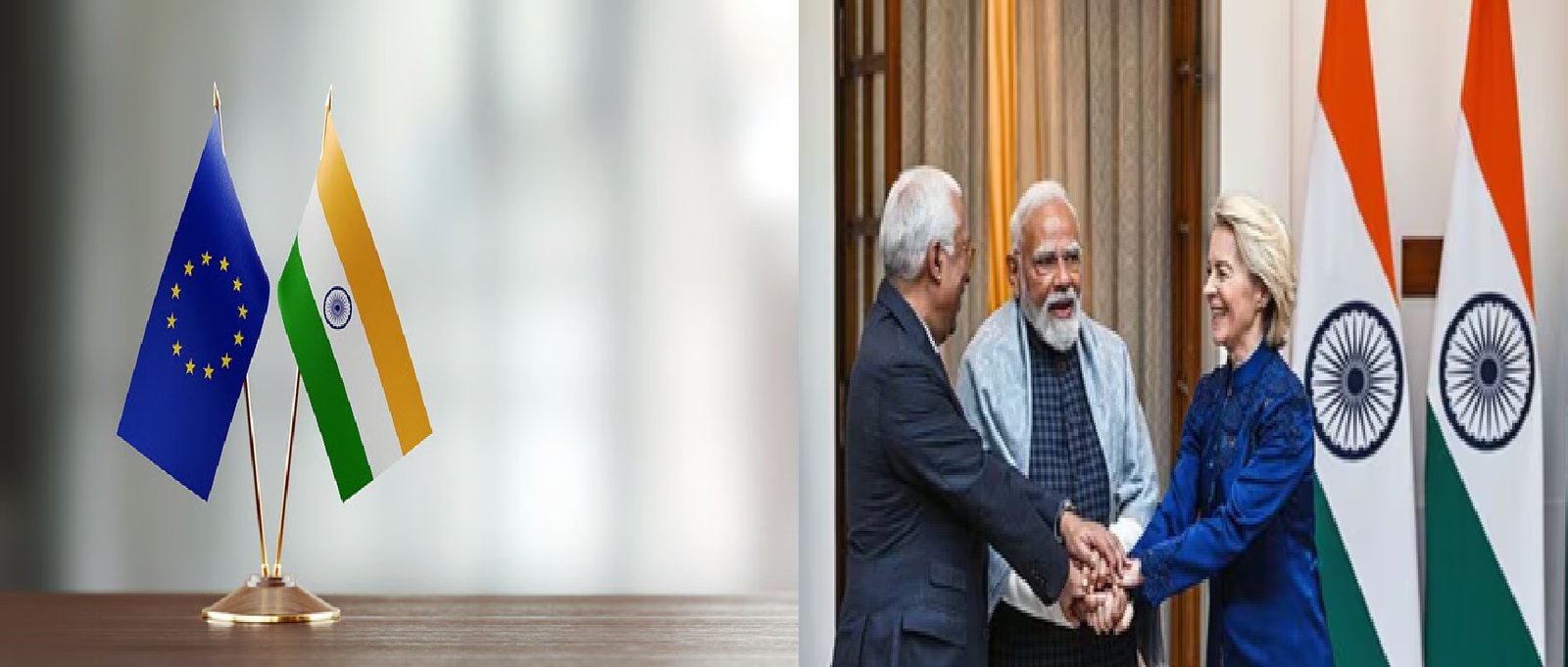
India–EU Free Trade Deal Expands Zero-Duty Access to Europe, Reshaping Global Trade Dynamics
India–EU Free Trade Deal Expands Zero-Duty Access to Europe, Reshaping Global Trade Dynamics
The India–EU Free Trade Agreement grants expanded zero-duty access to European markets, boosting Indian exports and reshaping global trade, especially in textiles, manufacturing, and services.
Amit Kaul – For Business Desk, Bengaluru: February 2, 2026 – India and the European Union have concluded a landmark Free Trade Agreement (FTA) that significantly expands zero-duty market access for Indian goods across Europe. The deal, widely regarded as one of the most consequential trade partnerships of the decade, is expected to accelerate India’s export growth, strengthen supply chains, and shift competitive dynamics in key sectors such as textiles, engineering goods, pharmaceuticals, and digital services.
The agreement removes or sharply reduces tariffs on a wide range of Indian exports entering EU member states, making Indian products more price-competitive in one of the world’s largest consumer markets. With the EU representing a market of over 440 million people and high purchasing power, the FTA is projected to unlock substantial trade volumes and long-term investment opportunities.
India–EU Free Trade Deal Expands Zero-Duty Access to Europe: A Major Boost for Indian Exporters
One of the most immediate beneficiaries of the deal is India’s textile and apparel industry. For years, Indian exporters have faced tariff disadvantages compared to countries that already enjoyed preferential access to European markets. The new agreement levels the playing field by offering zero-duty or significantly reduced tariffs on garments, fabrics, and related products.
Industry experts believe this shift could result in a sharp rise in India’s textile exports to Europe, creating jobs across the manufacturing value chain—from cotton farmers and yarn producers to garment factories and logistics providers. The move is also expected to challenge the dominance of competing exporters that previously enjoyed tariff advantages.
Engineering goods, auto components, chemicals, and processed food products are also set to gain from improved access. Small and medium enterprises (SMEs), which form the backbone of India’s export ecosystem, stand to benefit from simplified compliance procedures and reduced non-tariff barriers under the agreement.
Strategic Impact on Global Trade
Beyond bilateral trade, the India–EU FTA carries significant geopolitical and economic implications. As global supply chains diversify away from concentrated sourcing hubs, India is positioning itself as a reliable manufacturing and export partner. The agreement strengthens India’s integration with European production networks, particularly in high-value sectors like renewable energy equipment, precision engineering, and pharmaceuticals.
Trade analysts note that the deal could alter competitive equations in global markets, especially in textiles and light manufacturing, where tariff preferences play a decisive role. By securing zero-duty access, India gains a structural advantage that may reshape sourcing decisions by European retailers and manufacturers.
The FTA also reflects a broader alignment between India and the EU on rules-based trade, sustainability standards, and resilient supply chains. Both sides have emphasized cooperation in green technologies, digital trade, and innovation, signaling that the agreement goes beyond tariff cuts to include future-focused economic collaboration.
India–EU Free Trade Deal Expands Zero-Duty Access to Europe: Services, Technology, and Investment
In addition to goods, the agreement strengthens cooperation in services—an area where India has a well-established global presence. Sectors such as information technology, professional consulting, financial services, and digital innovation are expected to see deeper engagement between Indian firms and European markets.
Provisions related to mobility of skilled professionals, data flows, and regulatory transparency are likely to make it easier for Indian service providers to operate across EU countries. This could further boost India’s role as a global services hub.
European investment in India is also expected to rise. With improved trade certainty and regulatory cooperation, European companies may expand their manufacturing footprint in India, particularly in clean energy, electric mobility, advanced manufacturing, and sustainable infrastructure.
India–EU Free Trade Deal Expands Zero-Duty Access to Europe: Implications for Competing Exporters
The FTA is also being closely watched in other exporting nations that rely heavily on the European market. Countries that previously benefited from preferential tariff treatment in textiles and the light industry may face stiffer competition from Indian suppliers.
Trade experts suggest that sourcing patterns could gradually shift as European buyers seek cost advantages and diversify their supply chains. This development underscores India’s growing influence in global trade negotiations and its ability to secure strategic market access through diplomacy and economic reform.
Policy and Reform Momentum
The successful conclusion of the India–EU trade pact is seen as validation of India’s ongoing economic reforms, including improvements in logistics, digital governance, production-linked incentives (PLI), and ease of doing business. These measures have strengthened India’s credibility as a long-term trade and investment partner.
Government officials have emphasized that the FTA will complement domestic initiatives such as Make in India, Digital India, and green energy transitions. By combining internal reforms with expanded access to global markets, India aims to sustain high export growth and job creation.
India–EU Free Trade Deal Expands Zero-Duty Access to Europe: Looking Ahead
While implementation details and timelines will determine the full pace of benefits, early estimates suggest the agreement could significantly increase bilateral trade over the next decade. Businesses on both sides are now preparing to realign supply chains, explore joint ventures, and expand cross-border operations.
https://digitalamitkaul.online/india-economic-momentum-economic-survey-fy26-growth-outlook/
The India–EU Free Trade Agreement marks a decisive step in India’s emergence as a central player in global commerce. With zero-duty access to one of the world’s most important markets, Indian exporters are poised for a new phase of expansion that could redefine trade flows, industrial growth, and international economic partnerships in the years ahead.
Author Bio:
Amit Kaul is a seasoned journalist and digital content strategist with over a decade of experience covering business, technology, finance, and digital economy trends. Based in Bengaluru, India, he specializes in producing high-quality, data-driven news articles optimized for global audiences and digital platforms. Amit is passionate about financial inclusion, fintech innovations, and economic developments that shape India and the world. His work has been featured on multiple news portals and Google News platforms, providing readers with timely and reliable insights.



Pingback: US–China Trade Talks Resume in Geneva as Both Sides Push for Tariff Cuts and Tech Cooperation - ANN
Pingback: Oracle Considers Massive Job Cuts to Fund AI Infrastructure Expansion - ANN
Pingback: Global Markets Slide as AI Spending Fears Rattle Investors - ANN