

7 Resistance Band Exercises That Can Help Reduce Belly Fat and Build a Stronger Core
7 Resistance Band Exercises That Can Help Reduce Belly Fat and Build a Stronger Core
Discover 7 resistance band exercises to strengthen your core, burn calories, and support belly fat loss. Try this easy full-body workout at home.
HEALTH & FITNESS | WEIGHT LOSS | NOVEMBER 17, 2026
Belly fat can be stubborn, especially when long working hours, stress, poor sleep, and limited physical activity become part of everyday life. Many people turn to endless crunches or expensive gym memberships, hoping to achieve a flatter stomach.
But what if a simple resistance band could help you build a more effective workout routine at home?
Resistance bands are affordable, portable, and surprisingly versatile. They allow you to train major muscle groups, strengthen your core, and gradually increase resistance without relying on heavy gym equipment.
There’s one important fact to understand, however: No exercise can specifically target and eliminate fat from your belly. Research does not support the idea that repeatedly exercising one body part will selectively burn fat from that area.
Instead, reducing abdominal fat generally requires overall fat loss through sustainable nutrition, regular physical activity, and healthy lifestyle habits.
Resistance band training can contribute to that process by improving muscular strength, supporting lean muscle retention, and increasing overall physical activity.
https://aamnewsnetwork.com/benefits-of-walking-health-daily-steps/
Here are seven resistance band exercises worth including in your fitness routine.
1. Resistance Band Squats: Strengthen Your Largest Muscle Groups – 7 resistance band exercises
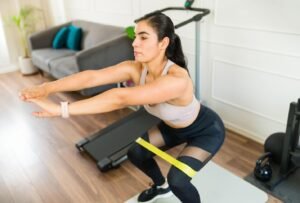
Squats are among the most effective compound exercises because they engage several major muscle groups simultaneously.
The difficulty is increased, and improved hip and glute activation may result from the addition of a resistance band.
How to perform:
A loop resistance band should be positioned somewhat above your knees. Place your feet about shoulder-width apart.
Push your hips backward and bend your knees as though sitting in a chair. Keep your chest lifted, heels grounded, and knees aligned with your toes.
Slowly return to standing.
Recommended repetitions: 12–15 repetitions, 2–3 sets.
Benefits: Strengthens the quadriceps, glutes, and hamstrings while challenging lower-body stability.
Because large muscle groups are involved, squats can contribute to energy expenditure and help preserve strength during a weight-loss programme.
2. Standing Band Crunches: Challenge Your Abdominal Muscles
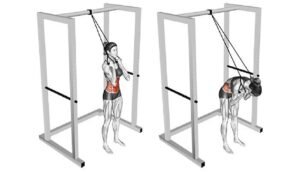
Standing band crunches offer an alternative to traditional floor crunches.
They primarily target the rectus abdominis, the abdominal muscle responsible for bending the trunk forward.
How to perform:
Secure a resistance band to a suitable overhead anchor and check that it is firmly attached.
Hold the band near your shoulders and stand or kneel with your feet stable.
Contract your abdominal muscles and gently curl your rib cage toward your pelvis without pulling excessively with your arms.
Return slowly to the starting position.
Recommended repetitions: 10–15 repetitions, 2 sets.
Benefits: Improves abdominal strength and muscular control.
Although standing crunches can strengthen your stomach muscles, they do not directly remove the fat covering them.
3. Resistance Band Woodchoppers: Train Your Core Through Rotation

Woodchoppers are dynamic exercises that challenge the abdominal muscles, obliques, and stabilizing muscles around the trunk.
They imitate the diagonal movement involved in activities such as swinging a racket or reaching across the body.
How to perform:
Attach a resistance band securely to a stable anchor at approximately shoulder height.
Stand sideways to the anchor, holding the band with both hands.
With controlled movement, pull the band diagonally across your body while allowing your torso to rotate naturally. Avoid twisting your knees or forcing your lower back.
Return slowly and repeat on the opposite side.
Recommended repetitions: 10–12 per side, 2 sets.
Benefits: Improves rotational strength, coordination, and core stability.
Start with light resistance to avoid unnecessary strain on your spine.
4. Banded Glute Bridges: Strengthen Your Glutes and Hips
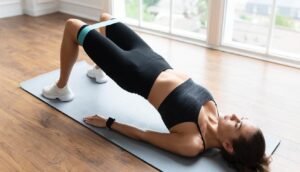
Glute bridges are often overlooked in weight-loss workouts because they do not feel as intense as jumping or running.
However, they strengthen muscles that are essential for walking, climbing stairs,s and maintaining lower-body stability.
How to perform:
With your feet flat on the ground and your knees bent, lie on your back.
Above your knees, place a loop resistance band.
Press your heels into the ground, engage your glutes, and lift your hips until your shoulders, hips, and knees form a relatively straight line.
Keep your knees aligned against the band’s resistance, then lower slowly.
Recommended repetitions: 12–15 repetitions, 2–3 sets.
Benefits: Increases hip stability and strengthens the glutes.
Glute bridges are particularly useful for people who spend much of their day sitting.
https://digitalamitkaul.online/jump-rope-15-min-weight-loss-workout/
5. Resistance Band Mountain Climbers: Combine Cardio and Core Training
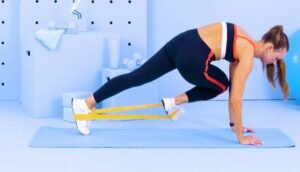
Cardiovascular exercise and core stability are combined in mountain climbers.
Adding a resistance band increases the challenge, making this exercise more demanding than the standard version.
How to perform:
Put your hands behind your shoulders and start in a high plank position.
Place a suitable loop band around your feet, ensuring it cannot slip unexpectedly.
Bring one knee toward your chest against the band’s resistance, then return to the starting position.
Alternate legs while keeping your hips stable.
Recommended duration: 20–30 seconds, 2–3 rounds.
Benefits: Challenges the abdominal muscles, shoulders, hip flexors, and cardiovascular system.
Beginners should master ordinary mountain climbers before introducing resistance.
6. Banded Deadlifts: Strengthen Your Posterior Chain
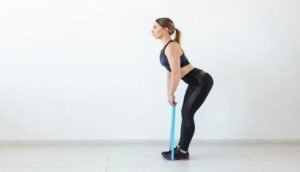
Deadlifts are powerful strength-building exercises that target the posterior chain—the muscles along the back of your body.
This exercise can be done at home using resistance bands.
How to perform:
Place your feet hip-width apart and stand firmly in the center of a long resistance band.
Keep the ends of the band securely at your sides.
Bend slightly at the knees and push your hips backward while keeping your spine neutral.
To stand again, drive through your feet and stretch your hips.
Avoid rounding your lower back or leaning backward at the top.
Recommended repetitions: 10–12 repetitions, 2–3 sets.
Benefits: Strengthens the glutes, hamstrings, and back muscles while improving hip-hinge mechanics.
Deadlifts can support overall strength and muscle retention during weight management.
7. Resistance Band Plank Row: Strengthen Your Core and Upper Body

The resistance band plank row combines two movements: plank and an upper-body pulling exercise.
It challenges your abdominal muscles to resist rotation while your back and arms work against resistance.
How to perform:
Begin in a high plank position with your feet slightly wider than shoulder-width.
Secure a long resistance band to a stable, low anchor in front of you.
Hold the band in one hand and pull your elbow toward your hip while keeping your torso as steady as possible.
Return slowly and switch sides.
Recommended repetitions: 8–10 per side, 2 sets.
Benefits: Strengthens the core, upper back, and shoulders while improving anti-rotation stability.
This is an advanced movement. Beginners can perform seated or standing band rows before progressing to plank rows.
7 resistance band exercises: 20-Minute Resistance Band Workout for Beginners
Complete one circuit, resting 20–45 seconds between exercises as needed. Allow approximately 20 minutes, including a brief warm-up and cool-down. As your fitness improves, gradually increase repetitions or add a second circuit.
For most beginners, two or three nonconsecutive resistance-training sessions per week provide a reasonable starting point.
Can Resistance Bands Really Help You Lose Belly Fat?
Resistance bands can support fat loss, but the distinction between strengthening abdominal muscles and reducing abdominal fat is important.
Belly fat includes subcutaneous fat, located beneath the skin, and visceral fat, which surrounds internal organs. Excess visceral fat is associated with increased cardiometabolic health risks.
Regular physical activity, including aerobic exercise and resistance training, can help reduce overall body fat and improve body composition. However, the amount of fat lost varies between individuals.
Resistance training also helps maintain muscle mass, which is particularly valuable when losing weight.
For broader health benefits, the World Health Organization recommends that adults accumulate 150–300 minutes of moderate-intensity aerobic activity per week, or an equivalent amount of vigorous activity, and perform muscle-strengthening activities at least twice weekly.
Combining resistance band workouts with brisk walking, balanced nutrition, sufficient sleep, and a sustainable calorie deficit is more likely to produce meaningful results than relying on abdominal exercises alone.
7 resistance band exercises: Five Common Mistakes That Can Limit Your Progress
Even simple exercises can become less effective when performed incorrectly.
– Using excessive resistance: Choose a band that allows you to complete each repetition with proper form.
– Rushing movements: Controlled repetitions help maintain muscular tension and reduce unnecessary strain.
– Ignoring recovery: Muscles need adequate rest between demanding sessions.
– Expecting targeted fat loss: Core exercises strengthen abdominal muscles but cannot selectively remove belly fat.
– Overlooking nutrition: Sustainable weight management requires attention to overall energy intake and dietary quality.
Inspect resistance bands for cracks or damage before use. Ensure anchors are secure, and avoid positioning stretched bands where they could snap toward your face.
The Bottom Line
Resistance bands offer a practical, affordable way to improve strength and fitness without expensive equipment.
From squats and deadlifts to woodchoppers and plank rows, these seven exercises target multiple muscle groups while challenging your core.
They won’t magically melt belly fat, but they can become an important part of a consistent, evidence-based weight-management routine.
The key is to begin at a manageable level, progress gradually, and combine exercise with healthy lifestyle habits.
Medical Disclaimer: This article provides general health and fitness information for educational purposes only. It is not a substitute for professional medical advice, diagnosis, or treatment. Consult a qualified healthcare professional before starting a new exercise programme if you have an existing medical condition, are pregnant, are recovering from an injury, or have concerns about exercise safety.
You don’t need to perform all seven exercises at maximum intensity to benefit from resistance training. Start with light resistance and focus on controlled movements.