
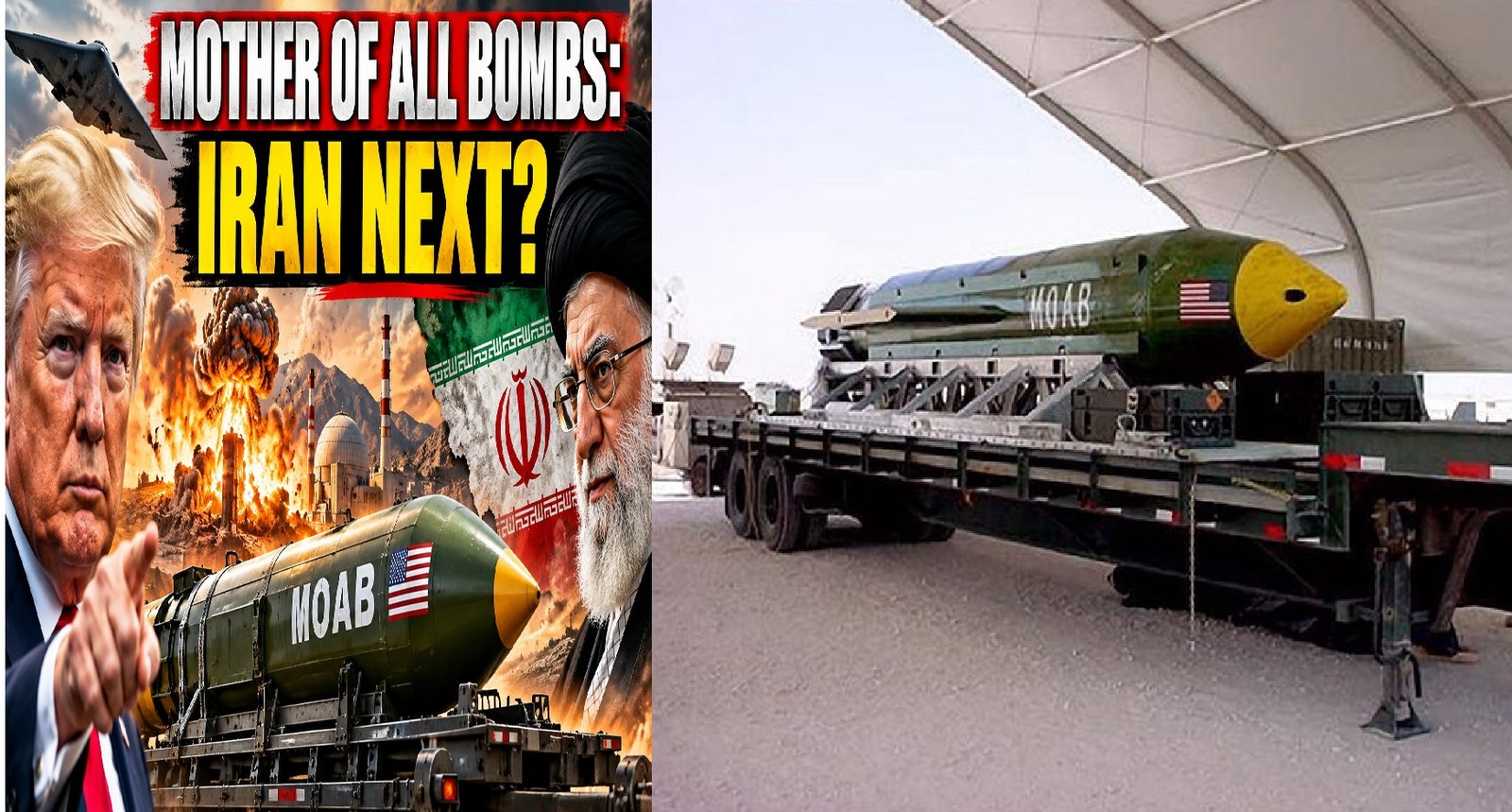
US May Use ‘Mother of All Bombs’ Against Iran: How Powerful Is the MOAB and Can It Destroy Nuclear Sites?
US May Use ‘Mother of All Bombs’ Against Iran: How Powerful Is the MOAB and Can It Destroy Nuclear Sites?
US May Use ‘Mother of All Bombs’ Against Iran: What is the US Mother of All Bombs? Explore the GBU-43/B MOAB’s destructive power, its first use in Afghanistan, and the implications of a potential US strike on Iran.
US–Iran Tensions: Could the ‘Mother of All Bombs’ Become Washington’s Next Military Option?
Amit Kaul – For Digital Desk, Bengaluru: October 15, 2026 – As tensions between Washington and Tehran continue to raise fears of a wider confrontation, reports of possible American military strikes against Iranian infrastructure have brought one of the world’s most formidable conventional weapons back into the spotlight: the GBU-43/B Massive Ordnance Air Blast bomb, better known as the Mother of All Bombs, or MOAB.
The reported military planning could involve attacks on strategically important Iranian facilities, potentially including energy infrastructure and nuclear-related installations. However, the distinction between military contingency planning and an approved operation is critical. There is no independently verified confirmation here that President Donald Trump has authorised the deployment of the MOAB against Iran.
https://aamnewsnetwork.com/us-iran-conflict-end-trump-khamenei-14-point-draft/
The possibility nevertheless raises an important question: what makes this enormous American bomb so destructive, and would it actually be effective against Iran’s heavily protected nuclear facilities?
What Is the Mother of All Bombs?
The GBU-43/B is a massive, precision-guided, non-nuclear bomb developed for the United States Air Force.
Weighing approximately 9,800 kilograms, or 21,600 pounds, it is among the largest conventional bombs ever deployed in combat by the United States.
Its nickname, Mother of All Bombs, comes from its abbreviated designation, MOAB, and its extraordinary explosive power.
Unlike nuclear weapons, which release energy through nuclear reactions, the MOAB relies on conventional explosives to produce an immense blast.
Its destructive effect comes primarily from powerful blast pressure, making it particularly effective against exposed targets, concentrations of personnel, and certain surface-level structures.
The weapon was developed in 2003, during preparations for the US-led invasion of Iraq. Its enormous size also makes it unusual: it is delivered from a military transport aircraft rather than carried by a conventional fighter jet.
US May Use ‘Mother of All Bombs’ Against Iran: How Powerful Is the MOAB?
9,800 kg
Approximate total weight
11 tons
Approximate TNT equivalent
2003
Year developed
2017
First combat deployment
The MOAB contains roughly 8,500 kilograms of explosive material and has an estimated explosive yield equivalent to approximately 11 tons of TNT.
Its blast can devastate personnel and structures within the affected area, although the actual damage depends on terrain, distance, surrounding buildings, and other conditions. Despite its reputation, the MOAB is not capable of producing devastation comparable to a nuclear weapon.
It is also important to distinguish the MOAB from specialised deep-penetration bunker-busting bombs. The MOAB is primarily designed to create a massive surface-level blast, not penetrate deeply buried fortified installations. That difference could prove decisive in any operation targeting Iran’s underground nuclear infrastructure.
When Was the Mother of All Bombs First Used?
The MOAB made its combat debut on April 13, 2017, when American forces dropped it on an Islamic State-Khorasan (ISIS-K) tunnel complex in Afghanistan’s Nangarhar province.
The strike targeted militants operating in a network of caves and tunnels. Initial Afghan government estimates indicated that 36 militants had been killed, although subsequent casualty estimates differed.
The Pentagon said the operation was intended to destroy militant infrastructure and reduce the risks faced by American and Afghan ground forces.
The Afghanistan operation demonstrated the MOAB’s destructive capability. However, it did not establish that the weapon would necessarily be effective against every kind of underground military installation.
US May Use ‘Mother of All Bombs’ Against Iran: Why Is the United States Considering the MOAB Against Iran?
According to a CNN report cited by Reuters on October 15, 2026, American military planners are considering the possible use of the MOAB in future operations against Iran.
The potential targets reportedly include energy infrastructure and nuclear facilities.
However, Reuters said it had not independently verified the report, and military officials were still debating whether the weapon would achieve Washington’s strategic objectives.
The reported planning comes despite Trump’s October 8 announcement that the United States would not resume strikes against Iran before the November 3 midterm elections. He cited ongoing negotiations while maintaining pressure on Tehran over its nuclear programme.
Could the MOAB Destroy Iran’s Underground Nuclear Facilities?
That remains a major question. Iran has invested heavily in protecting sensitive nuclear infrastructure, including facilities built underground.
The MOAB’s enormous blast could inflict extensive damage on exposed installations, but deeply buried and reinforced structures present a different challenge.
The United States also possesses the GBU-57 Massive Ordnance Penetrator, a specialised weapon designed to penetrate hardened targets before detonating.
Consequently, the MOAB’s impressive explosive yield does not automatically make it the best option for destroying deeply buried nuclear facilities.
US May Use ‘Mother of All Bombs’ Against Iran: What Would an Attack Mean for Global Oil Markets?
A renewed American bombing campaign targeting Iranian energy infrastructure could have consequences far beyond the battlefield.
Iran occupies a strategically important position near the Strait of Hormuz, a critical maritime passage for international energy shipments.
Further damage to regional infrastructure could disrupt supplies, raise transportation and insurance costs, and increase pressure on oil-importing economies.
The International Energy Agency has already highlighted the economic effects of the ongoing conflict, including constrained supplies and elevated fuel prices.
For ordinary households, another escalation could translate into more expensive petrol, diesel, transportation, and essential goods.
Could Military Escalation Help Trump Politically?
With the November 3 congressional midterm elections approaching, the Iran conflict has become a sensitive domestic political issue.
A decisive military success could strengthen the administration’s argument that its strategy is working. But another expensive confrontation, particularly one that drives fuel prices higher, could also deepen public dissatisfaction.
The central dilemma for Washington is whether further military force would produce meaningful strategic results or simply prolong the confrontation.
The Bigger Question: Can a Powerful Bomb End a War?
The Mother of All Bombs represents extraordinary conventional firepower, but military power and political success are not the same thing.
A single weapon may destroy a target. It cannot, by itself, guarantee the elimination of an entire nuclear programme, prevent retaliation, or deliver a lasting peace agreement.
https://digitalamitkaul.online/why-saudi-crown-prince-blocked-netanyahu-houthi-war-plan/
For the United States, the real challenge is not simply determining whether the MOAB can inflict devastating damage. It is deciding whether deploying such a weapon would bring Washington closer to its objectives—or push the Middle East into another dangerous phase of conflict.
For now, the reported MOAB option remains a contingency, not a confirmed military operation.
Author Bio:
Amit Kaul is a seasoned journalist and digital content strategist with over a decade of experience covering business, technology, finance, and digital economy trends. Based in Bengaluru, India, he specializes in producing high-quality, data-driven news articles optimized for global audiences and digital platforms. Amit is passionate about financial inclusion, fintech innovations, and economic developments that shape India and the world. His work has been featured on multiple news portals and Google News platforms, providing readers with timely and reliable insights.