
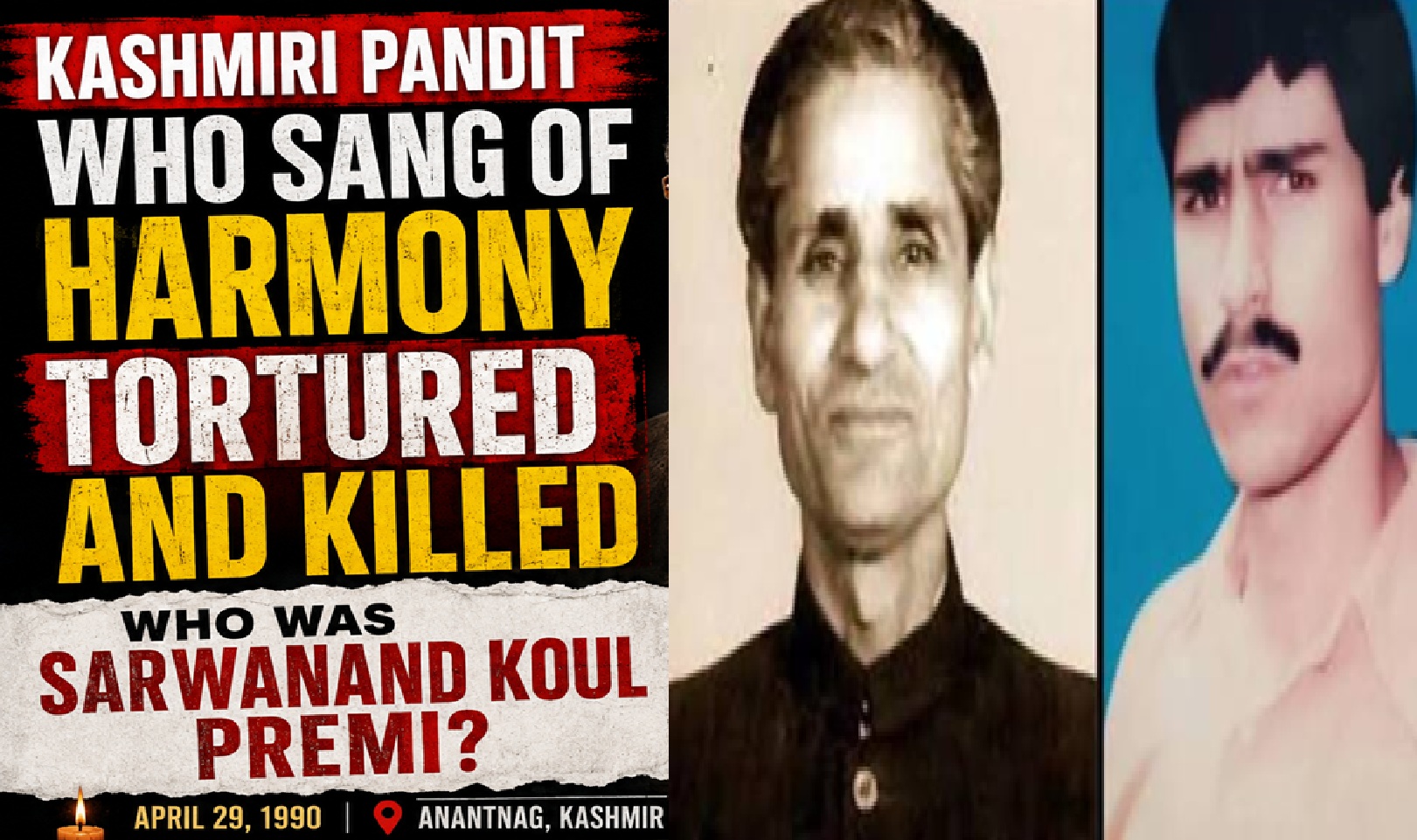
Who Was Sarwanand Koul Premi? The Kashmiri Pandit Poet Killed in 1990 Whose Case Has Returned to the Spotlight
Who Was Sarwanand Koul Premi? The Kashmiri Pandit Poet Killed in 1990 Whose Case Has Returned to the Spotlight
Who was Sarwanand Koul Premi? Explore the life, writings, and legacy of the Kashmiri Pandit poet, teacher, and social reformer killed with his son in 1990, as the SIA renews the investigation.
Amit Kaul – For Digital Desk, Bengaluru: August 15, 2026 – Thirty-six years after Sarwanand Koul “Premi” and his young son Virender Koul were abducted and killed in south Kashmir, the case has returned to the spotlight.
On August 12, 2026, the State Investigation Agency (SIA) of the Jammu and Kashmir Police conducted searches at nine locations across Jammu and Kashmir in connection with the 1990 double murder. The case was originally registered at Dooru police station in Anantnag and is now being investigated by the SIA. Investigators have not publicly disclosed the identities of those being searched or the precise material recovered, making the operation an important investigative development but not, by itself, proof of guilt against any individual.
The renewed investigation also comes shortly after the SIA filed a 737-page chargesheet in the 1990 killing of Kashmiri Pandit nurse Sarla Bhat, naming former JKLF chief Yasin Malik and four others as accused. Together, the two cases illustrate how agencies are revisiting some of the unresolved crimes of the early militancy period in Kashmir.
But who exactly was Sarwanand Koul Premi—and why does his story remain so powerful?
https://aamnewsnetwork.com/instagram-telegram-crypto-three-app-model-nia-digital-terror-india/
A poet, teacher, and freedom fighter
Born in Anantnag in 1924, Premi was much more than a victim of the violence that engulfed Kashmir in 1990.
He was a poet, writer, educator, translator, social reformer, Gandhian, and freedom-movement activist. Accounts of his life record his involvement in the Quit India Movement and later in the Quit Kashmir Movement. He also worked in education for decades and became a respected teacher in South Kashmir.
His literary work was extensive. Among the works associated with him are translations and adaptations of major Indian literary and spiritual texts, including the Bhagavad Gita, Ramayana, and Rabindranath Tagore’s Gitanjali, alongside original writings on Kashmir’s culture, saints, and society.
The significance of those translations went beyond literature.
Premi was attempting to make cultural traditions accessible across linguistic and community boundaries. His writings reflected an understanding of Kashmir in which Hindu and Muslim cultural influences were not necessarily competing identities but parts of a shared social landscape.
That philosophy helps explain the meaning of his surname, “Premi”—a person associated with love.
His idea of Kashmir was built around coexistence
Premi’s public life was closely associated with communal harmony, national integration, and social service.
Accounts of his work describe his efforts on behalf of disadvantaged people and his commitment to relationships that crossed religious boundaries. He was remembered by admirers as someone who believed that Kashmiri society could preserve its pluralistic character despite political and religious differences.
This aspect of his life is particularly important when examining his death.
Premi was not simply a member of the Kashmiri Pandit community living in a village that became caught in the violence of 1990. He represented, in the eyes of those who remembered him, a particular idea of Kashmiriyat—a cultural ethos associated with coexistence, shared traditions and social bonds across communities.
That is why his killing became symbolic for many Kashmiri Pandits.
The night Premi and his son disappeared
On the night of April 29, 1990, armed militants entered the Koul family’s home in Soaf Shali in the Kokernag area of Anantnag, according to accounts of the incident.
Premi, then 66, was taken from his home. His 27-year-old son Virender sensed the danger and accompanied his father.
They never returned.
Their bodies were recovered two days later, on May 1. Contemporary and later accounts describe the two men as having been tortured before being killed, and their bodies found hanging from a tree. The precise details of the assault have been reported differently in various accounts over the decades; they should therefore be treated with appropriate caution unless established through court findings or the current investigation.
The violence was devastating not only because two lives were lost but because of who the victims were and what they represented.
Premi had spent decades building bridges through education, writing, and social work. His son was a young man whose life was cut short alongside his father.
Why did the family stay?
The question of why the Koul family remained in Kashmir in 1990 is central to understanding the tragedy.
By that period, the Valley was experiencing an escalating insurgency, targeted violence, and growing fear among Kashmiri Pandits. Many families were leaving their ancestral homes.
Yet the Koul family stayed.
Premi’s long-standing relationships within the local community appear to have contributed to the family’s belief that they could remain in their homeland. Accounts remembering him describe him as highly respected among people from different communities, including former students.
That faith ultimately proved tragically misplaced.
His killing became part of the much larger story of the Kashmiri Pandit exodus, in which fear, targeted attacks, threats and the breakdown of social security contributed to the departure of a large section of the community from the Valley.
Yet it is important to distinguish between the individual crime and the wider historical debate. Premi’s murder was one episode within a complex and violent period involving insurgency, political conflict, militant organisations, communal fear and the collapse of trust. The crime must be investigated on its own evidence rather than reduced to a political slogan.
Why the 2026 SIA searches matter
The latest SIA searches are significant primarily because of the passage of time.
More than three decades have elapsed since the murders. Witnesses may have died, memories may have faded, and evidence may have become harder to recover.
Yet the SIA’s decision to revisit the case indicates that investigators believe there are still avenues worth pursuing.
The agency’s August 12 operation involved nine locations across Jammu and Kashmir, although authorities have so far provided limited public information about the results.
The development follows a broader effort to revisit legacy cases from the early years of militancy.
The Sarla Bhat investigation is a particularly relevant example. In June 2026, the SIA filed a 737-page chargesheet alleging the involvement of five JKLF operatives in her 1990 abduction and killing, including Yasin Malik. The case demonstrates both the possibilities and limitations of pursuing crimes decades after they occurred: investigators can still assemble documentary, forensic, medical, and testimonial material, but many accused may be dead, unavailable, or difficult to bring before a court.
Premi’s legacy is bigger than his murder
There is a danger that revisiting Premi only as a victim will obscure the life he actually lived.
He was a teacher who educated generations, a writer who expanded Kashmiri literature, a translator who connected traditions, and a social worker who promoted communal harmony.
His translations of the Gita, Ramayana and Gitanjali remain particularly significant because they reflect a literary philosophy that sought connection rather than isolation.
The Jammu and Kashmir administration has also formally recognised his contribution. His name has been included among the unsung heroes of India’s freedom movement, while a higher secondary school in his village was named after him in 2022. He was also posthumously honoured with a lifetime achievement award.
His cultural legacy has continued into 2026 as well: the Kashmir Education, Culture & Science Society lists the Sarwanand Kaul Premi Memorial Award among its recognitions.
The unanswered question of justice
The renewed investigation inevitably raises a painful question: Can justice still be achieved 36 years after a murder?
Legally, the answer depends on evidence.
Historically, however, justice can mean more than conviction. It can also mean establishing what happened, identifying those responsible, recording the testimony of survivors, and ensuring that victims are not reduced to statistics.
For the Koul family, the case has never been an abstract historical episode. It is the story of a father and son who left their home one rainy night and never came back.
For Kashmir, Premi’s story carries an even broader meaning.
He spent his life writing about harmony in a society increasingly divided by violence. He believed that literature, education, and human relationships could keep communities connected.
His murder became one of the darkest contradictions of that ideal.
Sarwanand Koul Premi is remembered not merely because he was killed in 1990, but because of what he stood for before he was killed: education over ignorance, dialogue over hatred, and Kashmir’s composite cultural tradition over communal division.
The SIA’s latest searches may eventually answer questions that have remained unresolved for decades. But whatever the outcome of the investigation, the enduring measure of Premi’s life lies not in the circumstances of his death alone.
It lies in the words, books, students, and ideals he left behind—and in the difficult question his life continues to ask Kashmir: Can a society recover from violence without recovering its memory of coexistence?
Author Bio:
Amit Kaul is a seasoned journalist and digital content strategist with over a decade of experience covering business, technology, finance, and digital economy trends. Based in Bengaluru, India, he specializes in producing high-quality, data-driven news articles optimized for global audiences and digital platforms. Amit is passionate about financial inclusion, fintech innovations, and economic developments that shape India and the world. His work has been featured on multiple news portals and Google News platforms, providing readers with timely and reliable insights.



Pingback: Major Security Breakthrough in Kashmir: 3 Held With Hizbul Posters, Grenades Amid Fresh Threats to Kashmiri Pandits - DNN
Pingback: NIA Arrests Nagar Panchayat Chairperson’s Son in Bihar AK-47 Arms Smuggling Case - ANN