
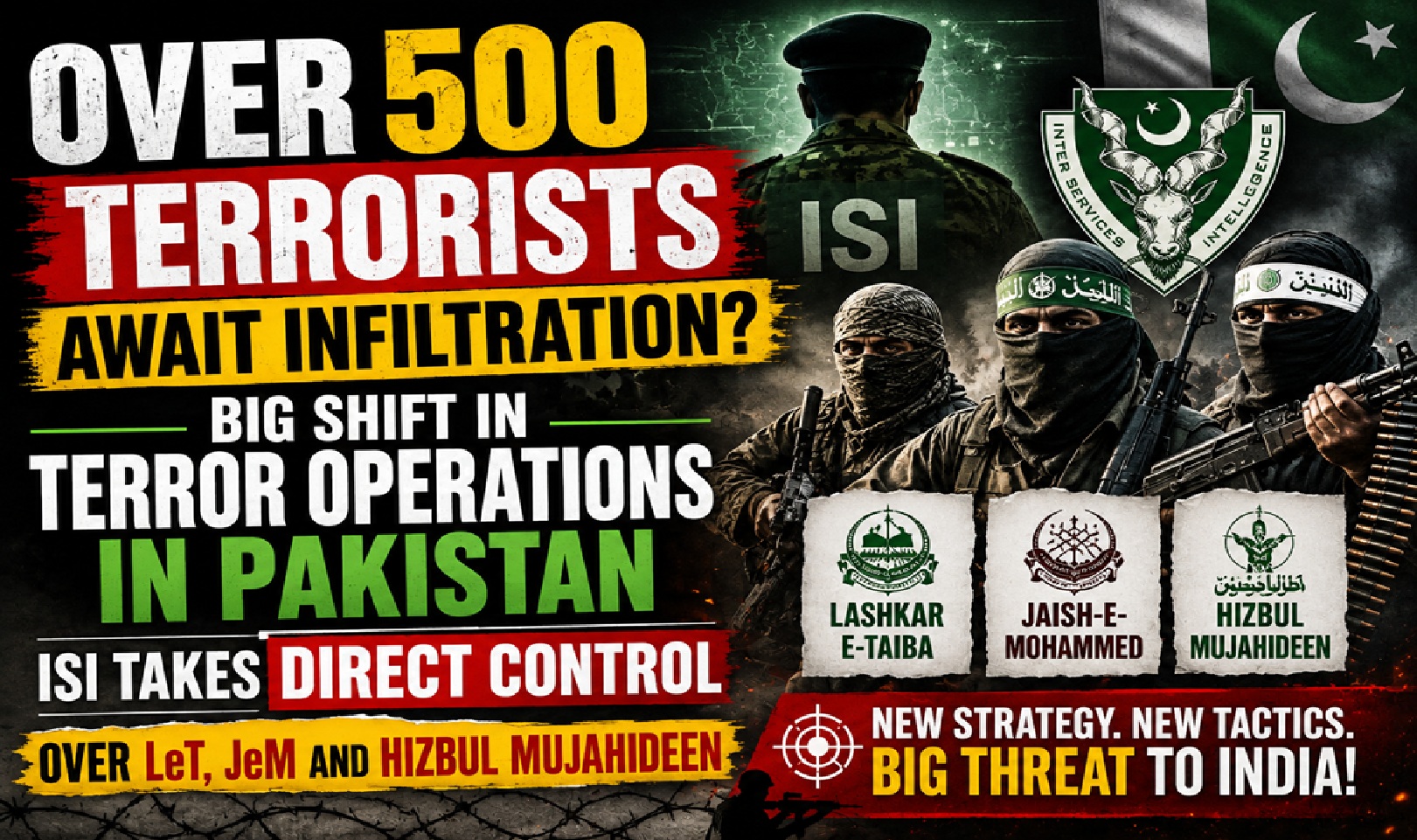
Over 500 Terrorists Await Infiltration? Big Shift in Pakistan’s Terror Operations as ISI Reportedly Tightens Control Over LeT, JeM and Hizbul Mujahideen
Over 500 Terrorists Await Infiltration? Big Shift in Pakistan’s Terror Operations as ISI Reportedly Tightens Control Over LeT, JeM and Hizbul Mujahideen
Over 500 Terrorists Await Infiltration? Intelligence inputs cited by IANS point to greater ISI coordination of LeT, JeM and Hizbul Mujahideen after Operation Sindoor, with more than 500 LeT terrorists reportedly awaiting infiltration.
Amit Kaul – For Digital Desk, Bengaluru: August 14, 2026 – The terrorist landscape along the India-Pakistan frontier may be undergoing a significant organisational change following Operation Sindoor, with Indian intelligence inputs pointing to greater coordination between Pakistan-based Lashkar-e-Taiba (LeT), Jaish-e-Mohammed (JeM) and Hizbul Mujahideen.
According to an IANS report citing Indian intelligence and security officials, the three groups are reportedly operating with a greater degree of coordination, while Pakistan’s Inter-Services Intelligence (ISI) has assumed a more direct supervisory role over their activities.
The claims have not been independently verified in public by Pakistan or through publicly available intelligence assessments. They should therefore be treated as intelligence-based allegations rather than facts. But if the reported restructuring is accurate, it could represent an important evolution in how Pakistan-based terror networks attempt to operate against India.
https://aamnewsnetwork.com/instagram-telegram-crypto-three-app-model-nia-digital-terror-india/
From separate outfits to greater operational coordination
Historically, LeT, JeM and Hizbul Mujahideen have maintained distinct organisational identities, leadership structures and operational networks. Their objectives and ideological backgrounds have not been identical, even though all three have been associated with militancy directed against India.
The reported change is that these distinctions may increasingly matter less at the operational level.
IANS reported that Indian intelligence inputs indicate that the three groups are now functioning under a more coordinated structure, with senior Pakistani intelligence officers allegedly supervising key decisions. The report identifies a Brigadier and a Colonel as being involved in oversight.
This would mark a shift from a model in which individual terrorist organisations and their handlers operated through relatively separate chains of command toward one in which coordination is allegedly being exercised through a common supervisory mechanism.
Over 500 Terrorists Await Infiltration? That distinction is strategically important.
A fragmented network can be disrupted by targeting individual organisations. A more integrated network, by contrast, can potentially redistribute personnel, logistics and responsibilities when one component comes under pressure.
Why Operation Sindoor may have accelerated the change
The reported restructuring needs to be understood against the backdrop of Operation Sindoor, launched by India on May 6-7, 2025, following the April 22 Pahalgam terrorist attack in which 26 people were killed.
India subsequently said its armed forces had struck nine terrorist infrastructure sites in Pakistan and Pakistan-occupied Jammu and Kashmir. The Indian government said the targets were associated with LeT, JeM and Hizbul Mujahideen.
The operation therefore went beyond the traditional pattern of counter-infiltration along the Line of Control (LoC). India demonstrated that terrorist infrastructure located deeper inside Pakistan could also become a target.
That creates a new strategic problem for terrorist organisations.
Fixed headquarters, predictable launchpads and concentrated training facilities can become liabilities if an adversary possesses the intelligence and military capability to target them. A logical response for an armed network is therefore to become more decentralised, mobile and compartmentalised.
The reported greater coordination among LeT, JeM and Hizbul Mujahideen may reflect precisely such an adaptation.
Over 500 Terrorists Await Infiltration? The “500 terrorists” figure needs context
One of the most attention-grabbing elements of the reporting is the claim that more than 500 terrorists are waiting across the LoC for opportunities to infiltrate Jammu and Kashmir.
However, there is an important qualification.
A May 26 IANS report specifically said that LeT alone had more than 500 terrorists waiting to infiltrate Jammu and Kashmir. The report also stated that most infiltration attempts had failed and that the organisation was considering additional launchpads in Pakistan-occupied Kashmir.
Therefore, it would be misleading to present the figure as a confirmed combined total of LeT, JeM and Hizbul Mujahideen personnel.
The number should instead be attributed to the intelligence assessment cited by IANS and treated as an estimate.
Nevertheless, even an intelligence estimate of this scale would indicate a substantial potential manpower pool and a continuing emphasis on cross-border infiltration.
Smaller mixed groups could complicate counter-terrorism
Another reported change is the alleged use of smaller mixed teams, rather than larger infiltration groups associated with a single organisation.
From a counter-terrorism perspective, that could be significant.
A mixed network potentially makes attribution and disruption more complicated. If personnel associated with different organisations operate together, security agencies may have to track several organisational links simultaneously.
The network as a whole is not always at risk when one group is lost.
This does not mean such tactics are unprecedented. Terrorist organisations have historically used small cells and inter-organisational cooperation. Indeed, Indian intelligence reporting had already identified operational coordination between LeT, JeM and Hizbul Mujahideen years before Operation Sindoor. A 2020 Hindustan Times investigation based on intelligence inputs described efforts to create operational synergy among these organisations.
The potentially new element is therefore not cooperation itself, but the reported degree of centralised coordination and direct supervision.
Over 500 Terrorists Await Infiltration? ISI’s alleged role is the biggest strategic question
The most consequential part of the latest assessment is the claim that operational decisions are increasingly being channelled through the ISI rather than being independently managed by individual terrorist-group leaderships.
If accurate, this would suggest a move toward tighter coordination of multiple networks under a common supervisory structure.
For India, that changes the counter-terrorism equation.
Instead of treating LeT, JeM and Hizbul Mujahideen entirely as separate threats, agencies may increasingly need to examine their networks as interconnected components of a broader ecosystem involving recruitment, financing, propaganda, handlers, logistics and infiltration.
It could also explain why smaller, mixed teams are reportedly being used.
However, the alleged involvement of specific ISI officers should remain attributed to the intelligence reporting. Publicly available evidence does not independently establish the complete command structure described in the IANS account.
The recruitment strategy may be shifting too
The second major development concerns recruitment.
According to the intelligence inputs cited in the reporting, Pakistan’s ISI is allegedly seeking alternatives to its traditional recruitment networks in Jammu and Kashmir, where local recruitment by established militant organisations has weakened. The reported strategy involves greater reliance on networks outside Jammu and Kashmir, including Afghanistan and parts of Africa, alongside attempts to influence potential recruits through different channels.
This is consistent with a broader challenge facing terrorist organisations: when local recruitment declines, they have to search for new ways to maintain manpower and operational capacity.
An earlier IANS report in August 2025, citing former Tehrik-e-Taliban Pakistan commander Ehsanullah Ehsan, also described declining recruitment into LeT, JeM and Hizbul Mujahideen in Kashmir, while arguing that the groups had not disappeared but were adapting to changing conditions. His comments were his own assessment rather than independent confirmation of ISI strategy.
More recently, an IANS report in June 2026 said intelligence inputs indicated an alleged attempt to create new recruitment networks in Jammu and Kashmir, including a proposed women-led recruitment structure.
Taken together, these reports point toward a possible trend: the weakening of traditional local recruitment may be encouraging terrorist networks to diversify recruitment and influence mechanisms.
Over 500 Terrorists Await Infiltration? Why this matters for Jammu and Kashmir
The broader strategic picture is straightforward.
India’s security architecture has increasingly focused on preventing infiltration before armed groups can establish themselves inside Jammu and Kashmir. If terrorist organisations respond by moving toward smaller groups, mixed teams, alternative recruitment pipelines and greater central coordination, the challenge becomes more difficult to detect.
Yet there is also a countervailing factor.
The more tightly multiple organisations are integrated, the more interconnected their networks become. That can create vulnerabilities: disruption of a shared handler, communication channel, financing mechanism, or logistics node could potentially affect multiple groups simultaneously.
In other words, greater synergy can increase operational efficiency—but it can also create a larger intelligence target.
Over 500 Terrorists Await Infiltration? The bigger strategic shift
The significance of the latest intelligence assessment lies less in the headline figure of 500 than in the alleged organisational evolution behind it.
Operation Sindoor demonstrated that terrorist infrastructure in Pakistan and Pakistan-occupied Jammu and Kashmir could face direct Indian military pressure. India has publicly stated that the operation targeted nine terror sites associated with LeT, JeM and Hizbul Mujahideen.
If the subsequent intelligence assessment is accurate, the groups may now be attempting to adapt through greater coordination, smaller operational teams, diversified recruitment and more centralised supervision.
For India, that means the next phase of counter-terrorism may not simply be about stopping infiltration at the LoC. It could increasingly involve identifying and disrupting the networks that coordinate recruitment, financing, handlers and cross-border movement before they translate into an operational threat.
The central question, therefore, is not merely whether 500 or more terrorists are waiting to infiltrate.
The more important question is whether Pakistan-based terror organisations are being reorganised into a more integrated and resilient network—and whether that network can be disrupted before its personnel reach Indian territory.
For now, the available information remains intelligence-based and requires independent verification. But if the reported restructuring continues, it could mark one of the most consequential changes in the operational architecture of Pakistan-based terrorism against India since Operation Sindoor.
Author Bio:
Amit Kaul is a seasoned journalist and digital content strategist with over a decade of experience covering business, technology, finance, and digital economy trends. Based in Bengaluru, India, he specializes in producing high-quality, data-driven news articles optimized for global audiences and digital platforms. Amit is passionate about financial inclusion, fintech innovations, and economic developments that shape India and the world. His work has been featured on multiple news portals and Google News platforms, providing readers with timely and reliable insights.


Pingback: Why India Wants 114 More Rafales and What Gives the Fighter Its Edge - ANN