
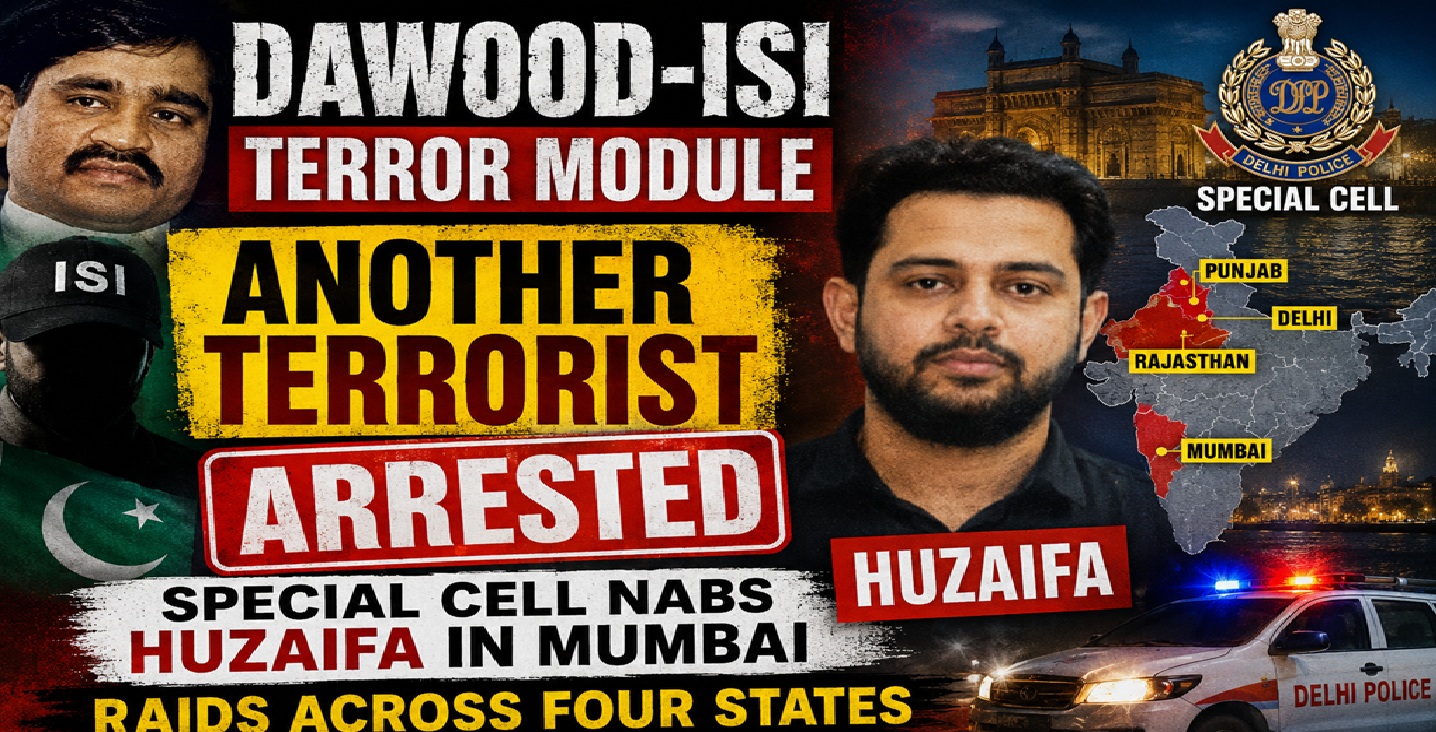
DAWOOD-ISI TERROR NETWORK EXPOSED! Another Operative Arrested in Mumbai
DAWOOD-ISI TERROR NETWORK EXPOSED! Another Operative Arrested in Mumbai
DAWOOD-ISI TERROR NETWORK EXPOSED- Delhi Police Special Cell arrests Huzaifa, a key operative linked to the Dawood Ibrahim-ISI terror network, from Mumbai after extensive raids across four states. Deeper ties between D-Company, Pakistan’s ISI, and terror recruitment activities in India are revealed by the arrest.
Another Major Breakthrough in India’s Fight Against Cross-Border Terrorism
Amit Kaul – For Digital Desk, Bengaluru: June 3, 2026 – In a significant development in India’s ongoing battle against cross-border terrorism and organized crime, the Special Cell of the Delhi Police has arrested Huzaifa, a suspected terrorist linked to a sprawling terror module allegedly operated by Pakistan’s Inter-Services Intelligence (ISI), underworld don Dawood Ibrahim’s D-Company, and Pakistan-based gangster Shahzad Bhatti.
The arrest, carried out in Mumbai following days of coordinated operations involving the Delhi Police Special Cell and the Mumbai Anti-Terrorism Squad (ATS), marks another critical breakthrough in dismantling a network believed to be working at the intersection of organized crime and terrorism.
Authorities describe Huzaifa as a close associate of Munna Jhingada, a key ISI operative and an influential figure within the D-Company ecosystem who reportedly operates from Karachi under the protection of Pakistan-based networks.
The Growing Nexus Between D-Company and Terror Networks
The latest arrest once again highlights the long-standing allegations regarding the nexus between organized crime syndicates and anti-India terror infrastructure operating from Pakistani soil.
Security agencies have repeatedly maintained that D-Company, originally established as a criminal enterprise, has evolved over the decades into a strategic asset used by hostile intelligence agencies to facilitate recruitment, financing, logistics, and covert operations inside India.
Investigators believe that Munna Jhingada played a crucial role in directing the activities of operatives within India while receiving instructions from handlers based in Karachi. According to preliminary findings, Huzaifa allegedly acted on instructions issued through this command structure and maintained operational links with other members of the terror module.
His arrest is expected to provide investigators with valuable intelligence on communication channels, recruitment methods, funding routes, and future operational plans.
DAWOOD-ISI TERROR NETWORK EXPOSED – Month-Long Multi-State Operation
The arrest did not occur in isolation. According to officials, the Delhi Police Special Cell had been conducting an extensive, intelligence-driven operation for nearly a month.
Acting on specific inputs received from the Intelligence Bureau (IB), security agencies launched coordinated raids and surveillance operations across four states:
- Delhi
- Maharashtra (Mumbai)
- Rajasthan
- Punjab
The operation aimed to identify and neutralize members of a terror module believed to be functioning under the guidance of handlers based outside India.
Sources indicate that intelligence agencies had been tracking the movements and communications of several suspects before zeroing in on Huzaifa’s location in Mumbai.
The successful arrest demonstrates the increasing effectiveness of inter-agency coordination between central intelligence agencies, state police forces, and specialized anti-terror units.
DAWOOD-ISI TERROR NETWORK EXPOSED – Nine Terror Suspects Arrested So Far
With Huzaifa’s detention, the number of arrests linked to this terror module has risen to nine.
This figure suggests that investigators are dealing not merely with isolated individuals but potentially with a structured network designed to carry out coordinated activities across multiple regions.
Counter-terror experts note that modern terror ecosystems increasingly rely on decentralized cells that operate independently yet remain connected to a centralized command structure via encrypted communication channels and trusted intermediaries.
The dismantling of such networks requires sustained intelligence gathering, human intelligence sources, technical surveillance, and coordination among various law enforcement agencies.
Focus of Investigation: Recruitment and Targets
The investigation has now entered a crucial phase.
Security agencies are interrogating Huzaifa to determine the extent of recruitment undertaken by the network and identify additional operatives who may still be active.
One of the main goals is to determine:
- How many individuals were recruited into the D-Company-linked module?
- The nature of training and operational responsibilities assigned to recruits.
- Funding sources and financial channels.
- Potential targets identified by handlers based in Pakistan.
- The role played by Munna Jhingada in coordinating activities inside India.
Investigators are particularly interested in uncovering whether any planned attacks or disruptive activities were in advanced stages of preparation.
Any intelligence gathered from Huzaifa’s interrogation could lead to further arrests and the disruption of additional sleeper cells.
DAWOOD-ISI TERROR NETWORK EXPOSED – Why This Arrest Matters
The arrest carries significance beyond the detention of a single suspect.
It underscores the continuing security challenge posed by the convergence of organized crime networks, foreign intelligence agencies, and terror organizations. Such collaborations allow hostile actors to exploit criminal infrastructure for recruitment, logistics, funding, and operational support.
For Indian security agencies, dismantling these networks is essential not only to prevent terrorist attacks but also to weaken the ecosystem that sustains anti-national activities.
The operation also highlights the importance of proactive intelligence gathering. Rather than responding to an incident after it occurs, agencies appear to have successfully disrupted the network during its operational phase, potentially preventing future security threats.
The Road Ahead
As investigations continue, authorities are expected to intensify efforts to trace the full extent of the network’s activities. More arrests cannot be ruled out as agencies analyze digital evidence, financial transactions, and communication records recovered during the operation.
The arrest of Huzaifa represents another chapter in India’s broader campaign against cross-border terror networks and organized crime syndicates that continue to pose threats to national security.
While the immediate success belongs to the Delhi Police Special Cell and Mumbai ATS, the larger challenge remains identifying and dismantling the infrastructure that enables such networks to recruit, communicate, and operate across state boundaries.
The coming weeks may reveal whether Huzaifa’s interrogation leads investigators to an even larger web of operatives linked to the Dawood-ISI nexus, a network that security agencies have sought to dismantle for decades.
Author Bio:
Amit Kaul is a seasoned journalist and digital content strategist with over a decade of experience covering business, technology, finance, and digital economy trends. Based in Bengaluru, India, he specializes in producing high-quality, data-driven news articles optimized for global audiences and digital platforms. Amit is passionate about financial inclusion, fintech innovations, and economic developments that shape India and the world. His work has been featured on multiple news portals and Google News platforms, providing readers with timely and reliable insights.



Pingback: Operation Blue Star Anniversary: Security Tightened in Amritsar as Punjab Deploys Massive Multi-Layered Protection Grid - ANN
Pingback: Major Revelation in TCS Conversion Case: Nida Khan Admits to Providing Namaz Training, Investigation Widens - ANN
Pingback: Heavy Firing Along LoC for the First Time Since Operation Sindoor: Why Pakistan Escalated Tensions and What It Means for India - ANN
Pingback: Over 500 Terrorists Await Infiltration? Big Shift in Pakistan’s Terror Operations as ISI Reportedly Tightens Control Over LeT, JeM and Hizbul Mujahideen - DNN