
Petrol Was Once Cheaper Than Water in India: How Fuel Prices Skyrocketed From Paise to ₹100+ Per Liter
Petrol Was Once Cheaper Than Water in India: How Fuel Prices Skyrocketed From Paise to ₹100+ Per Liter
Petrol Was Once Cheaper Than Water in India: Petrol once cost just 25 paise per liter in India after independence. From hand-pump fuel stations to today’s ₹100+ petrol rates, here’s an in-depth look at how oil economics, taxes, wars, and global markets transformed fuel prices forever.
From 25 Paise to ₹100 Per Liter: India’s Petrol Price Journey Explained
Amit Kaul – For Digital Desk, Bengaluru: May 28, 2026 – In contemporary India, passing a gas station frequently causes financial distress. In many cities, including Delhi, petrol prices have crossed ₹100 per liter, making fuel one of the most discussed household expenses in the country.
But rewind the clock to 1947, the year India gained independence, and the story looks almost unbelievable.
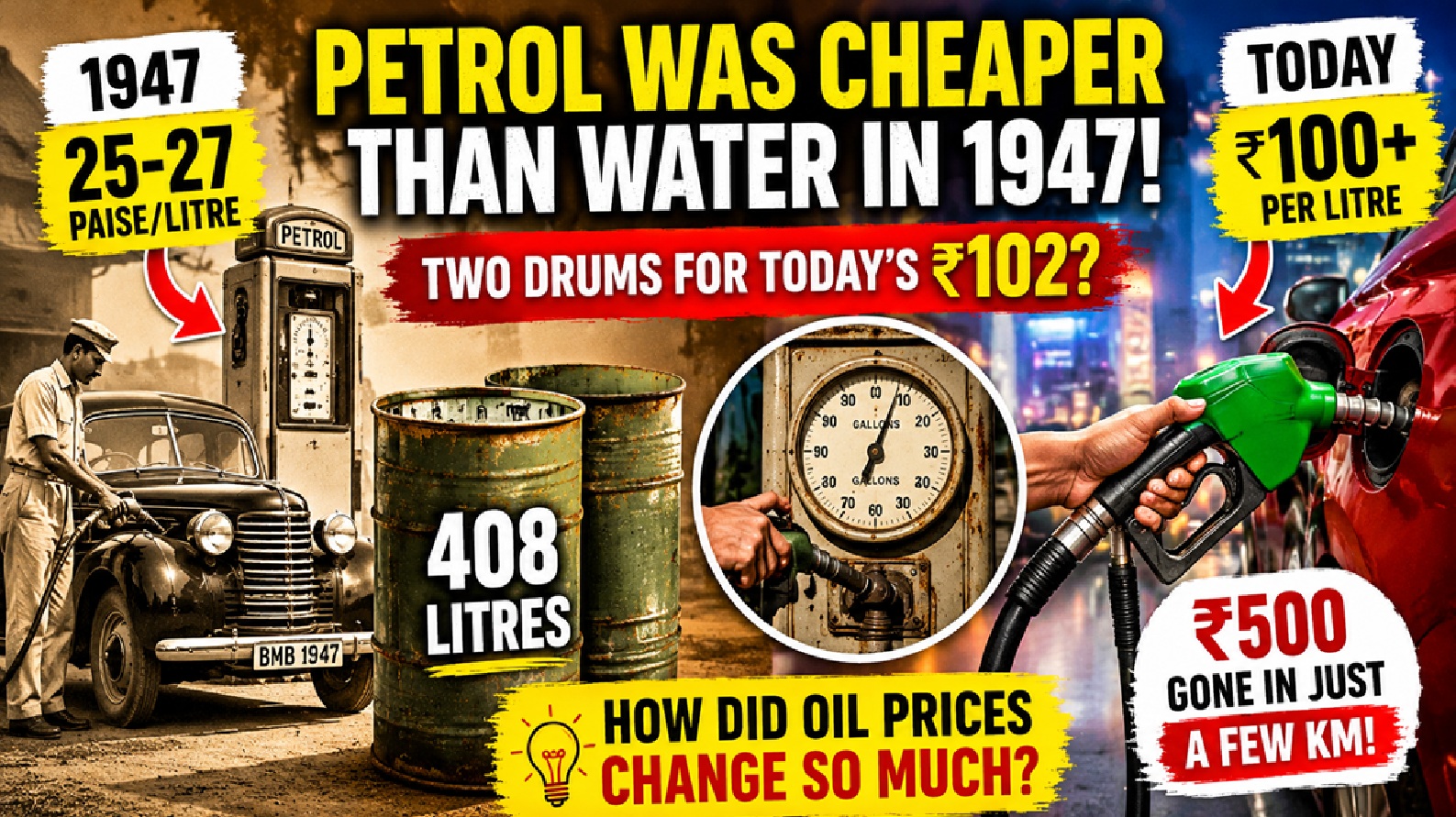
Back then, petrol reportedly cost between 25 and 27 paise per liter. In simple terms, the amount of money required to buy just one liter of petrol today could have purchased more than 400 liters in the late 1940s.
The comparison sounds shocking, but it also raises a deeper economic question: how did petrol become so expensive over the decades?
The answer lies in a complex mix of global geopolitics, taxation policies, inflation, rising demand, currency depreciation, and changing lifestyles.
https://aamnewsnetwork.com/expensive-crude-oil-impact-india-gdp-growth-inflation-fy27/
Petrol Was Once Cheaper Than Water in India: When Owning a Car Was a Luxury
In independent India’s early years, petrol consumption was extremely limited because vehicles themselves were rare.
Cars were considered status symbols reserved for wealthy businessmen, royalty, senior government officials, and elite families. Roads were sparsely populated with classic models such as the Ambassador, Fiat, and Chevrolet.
Unlike today’s traffic-heavy urban roads, there were very few private vehicles. As a result:
- Fuel demand remained low
- Imports were limited
- Urban transport systems were smaller
- Oil dependency was less intense
At that time, even a monthly salary of ₹100 to ₹150 was considered respectable. As a result, it might be deceptive to compare fuel prices directly without taking purchasing power into consideration.
Still, even after adjusting for inflation, petrol was significantly cheaper relative to modern-day prices.
India’s First Petrol Pump Looked Completely Different
India’s first petrol pump was established in Mumbai in 1928 during British rule. Interestingly, the fuel stations of that era looked nothing like today’s digitally automated outlets.
There were:
- No electronic displays
- No fuel cards or UPI payments
- No automated dispensing systems
- No CCTV-equipped stations
Instead, attendants manually operated hand pumps to dispense fuel. A circular mechanical dial with a moving needle indicated the quantity of petrol delivered.
In keeping with the simplicity of India’s early vehicle economy, the system was wholly mechanical and labor-driven.
At the time, petrol reportedly cost around 6 paise per liter — an unimaginable figure by today’s standards.
Petrol Was Once Cheaper Than Water in India: Petrol Was Sold in Gallons, Not Liters
Another fascinating aspect of India’s fuel history is that petrol was not originally sold in liters.
Before 1960, India followed the imperial measurement system inherited from British administration. Fuel was sold in gallons, with one gallon equivalent to approximately 4.5 liters.
Later, the Government of India adopted the metric system, standardizing fuel sales in liters across the country.
This transition reflected India’s broader modernization efforts during the post-independence industrial era.
So, Why Did Petrol Become So Expensive?
The dramatic rise in fuel prices over the decades did not happen because of a single reason. Several economic and geopolitical forces combined to reshape global oil markets.
1. Rising Global Crude Oil Prices
Nearly 85% of India’s crude oil needs are met by imports. This means domestic petrol prices are heavily influenced by international crude oil markets.
Major events that caused oil price spikes include:
- The 1973 Oil Crisis
- Gulf Wars
- Iran-related tensions
- Russia-Ukraine conflict
- OPEC production cuts
- Global supply chain disruptions
Whenever global crude prices rise, Indian fuel prices eventually increase as well.
2. Heavy Central and State Taxes
One of the biggest reasons behind expensive petrol in India is taxation.
Petrol prices in India include:
- Central excise duty
- State VAT
- Dealer commissions
- Transportation costs
- Refining charges
In some states, taxes account for nearly 45% to 55% of the retail fuel price.
Governments rely heavily on fuel taxation because it generates massive revenue without direct income tax collection pressure.
This explains why even when international crude prices decline, retail petrol prices may not fall proportionately.
3. Rupee Weakness Against the Dollar
US dollars are used to trade crude oil worldwide.
Over the decades, the Indian rupee has weakened significantly against the dollar. In the late 1940s and 1950s, the rupee held far stronger international purchasing power.
As the rupee depreciated:
- Oil imports became more expensive
- Refining costs increased
- Fuel transportation became costlier
This directly impacted Indian consumers.
4. Explosion in Vehicle Ownership
India today is one of the world’s largest automobile markets.
Unlike 1947, vehicles are no longer luxury items. Millions of cars, scooters, trucks, and bikes are sold annually.
This explosion in vehicle ownership dramatically increased fuel demand.
Modern lifestyles, urban expansion, app-based transportation, logistics growth, and highway infrastructure have made petrol consumption central to India’s economy.
Higher demand naturally exerts upward pressure on fuel pricing.
Petrol Was Once Cheaper Than Water in India: Petrol Prices Reflect More Than Fuel Costs
Economists argue that petrol prices are now indicators of broader economic conditions.
Fuel directly impacts:
- Inflation
- Food prices
- Transportation costs
- Airline fares
- Manufacturing expenses
- Household budgets
When petrol becomes expensive, almost every sector of the economy feels the pressure.
This is why fuel pricing has become not just an economic issue, but also a political and social one.
Could Petrol Ever Become Cheap Again?
Experts believe petrol prices may remain volatile in the coming years because of global uncertainty and energy transition policies.
However, India is gradually pushing toward alternatives such as:
- Electric vehicles (EVs)
- Ethanol blending
- Green hydrogen
- Solar-powered transport systems
The long-term goal is to reduce dependence on imported crude oil.
https://digitalamitkaul.online/strait-of-hormuz-crisis-global-energy-supply/
Still, for millions of Indians today, the nostalgia of “25 paise petrol” serves as a powerful reminder of how dramatically India’s economy — and the world itself — has transformed since independence.
Author Bio:
Amit Kaul is a seasoned journalist and digital content strategist with over a decade of experience covering business, technology, finance, and digital economy trends. Based in Bengaluru, India, he specializes in producing high-quality, data-driven news articles optimized for global audiences and digital platforms. Amit is passionate about financial inclusion, fintech innovations, and economic developments that shape India and the world. His work has been featured on multiple news portals and Google News platforms, providing readers with timely and reliable insights.