
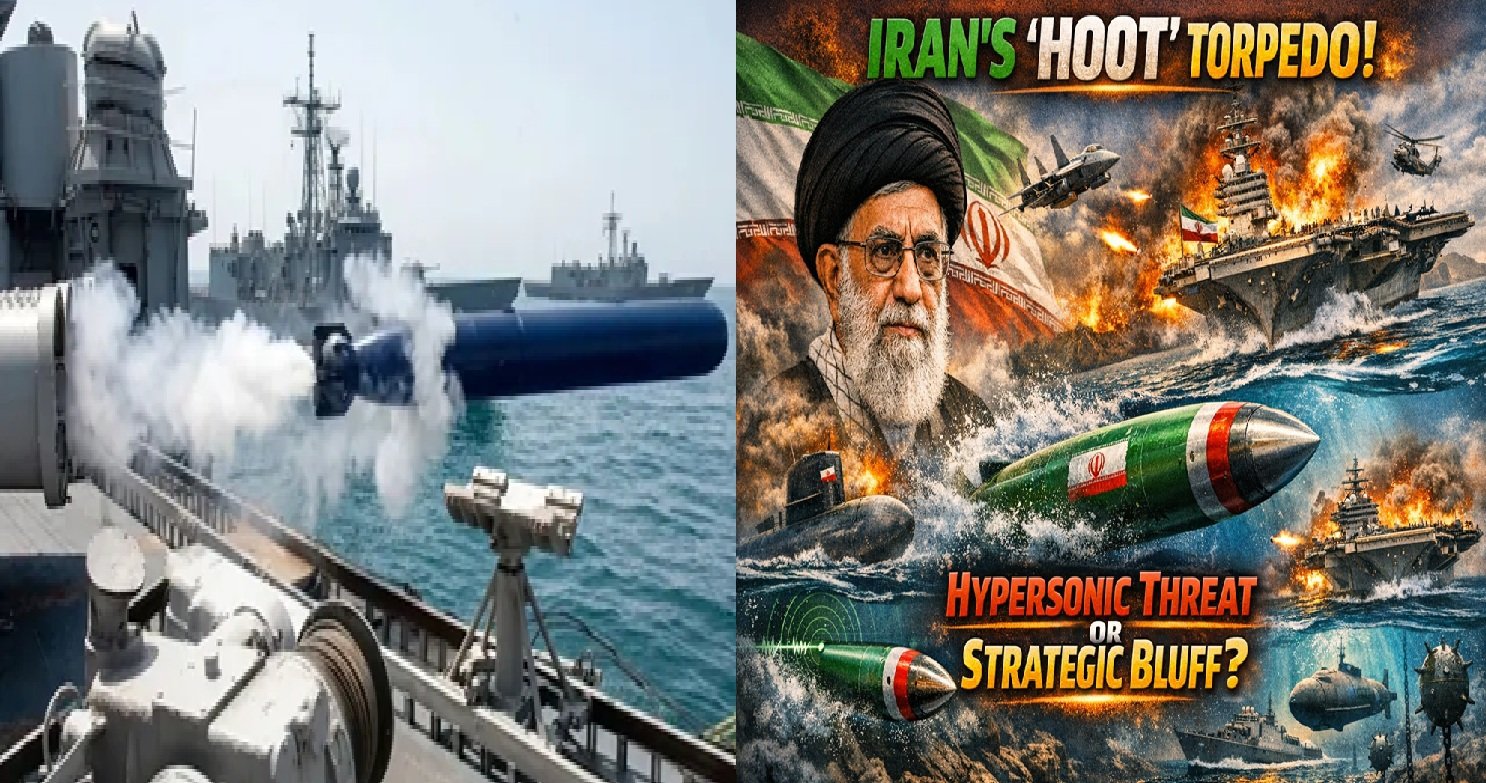
Iran’s ‘Hoot’ Torpedo: Hypersonic Threat or Strategic Bluff Beneath the Waves?
Iran’s ‘Hoot’ Torpedo: Hypersonic Threat or Strategic Bluff Beneath the Waves?
Iran’s ‘Hoot’ Torpedo: Iran’s ‘Hoot’ supercavitating torpedo promises devastating underwater speed, but can it truly threaten US aircraft carriers? A deep strategic and technological analysis.
Amit Kaul – For Digital Desk, Bengaluru: May 1, 2026 – Tensions in West Asia have once again entered a volatile phase, with rhetoric escalating alongside military signaling. The latest trigger comes from Iran’s naval leadership. Shahram Irani, commander of Iran’s Navy, recently hinted at a mysterious weapon capable of delivering a “heart attack” to adversaries—a phrase clearly designed to provoke strategic ambiguity and psychological deterrence.
While Tehran has not explicitly named the system, defense analysts—including Sandeep Unnithan—believe the reference points toward the ‘Hoot’ torpedo, a weapon reportedly tested in secrecy around 2006. If accurate, this signals not a new invention, but a re-emergence of an old capability being repackaged for modern geopolitical signaling.
What is the ‘Hoot’ Torpedo?
The ‘Hoot’ is believed to be a supercavitating torpedo—a class of underwater weapon that dramatically alters the physics of naval combat. Unlike conventional torpedoes, which move through water while battling immense drag forces, supercavitating systems exploit a fascinating principle known as Supercavitation.
This technology creates a gas bubble around the torpedo, effectively reducing friction with water. The result is extraordinary speed—reportedly exceeding 360 km/h, far beyond the 60–100 km/h range of traditional torpedoes. In simple terms, the ‘Hoot’ behaves less like a submarine weapon and more like an underwater rocket.
https://aamnewsnetwork.com/meloni-trump-russia-criticism-italy-political-image-analysis/
Such velocity offers a clear tactical advantage: drastically reduced reaction time for the target. In naval warfare, seconds can determine survival. A weapon that can close distance at such speed compresses the decision-making window for even the most advanced defense systems.
Additionally, reports suggest that the ‘Hoot’ can carry a warhead exceeding 200 kilograms, making it capable of inflicting severe structural damage if it successfully reaches its target.
The Strategic Reality: Strength Meets Limitation
Despite its impressive specifications, the ‘Hoot’ is far from a silver bullet. Its greatest strength—extreme speed—is also its Achilles’ heel.
Supercavitating torpedoes consume fuel at an extraordinary rate. As a result, their operational range is significantly limited, estimated at roughly 10–15 kilometers. By contrast, modern conventional torpedoes can strike targets at distances of 30 kilometers or more, often with greater guidance precision.
This limitation introduces a critical tactical challenge: launch proximity.
To effectively deploy the ‘Hoot’, Iranian platforms—whether submarines or surface vessels—would need to approach dangerously close to high-value targets such as US aircraft carriers. This is where theory collides with operational reality.
Iran’s ‘Hoot’ Torpedo: Can It Threaten US Aircraft Carriers?
Consider a carrier like the USS Abraham Lincoln. It is not merely a ship, but the centerpiece of a layered defense ecosystem known as a Carrier Strike Group (CSG).
This system includes:
- Advanced destroyers and cruisers equipped with missile defense systems
- Anti-submarine warfare (ASW) capabilities
- Airborne surveillance and early warning aircraft
- Electronic warfare and decoy systems
Moreover, aircraft carriers are engineered with robust compartmentalization and buoyancy controls, allowing them to survive significant damage. Sinking such a vessel is extraordinarily difficult—even for advanced militaries.
For Iran to deploy the ‘Hoot’ effectively, it would need to penetrate this multi-layered defense shield undetected and reach within striking distance. In open-sea conditions, such an approach would be highly risky and potentially suicidal, as noted by multiple defense experts.
Iran’s ‘Hoot’ Torpedo: Psychological Warfare or Real Capability?
Iran’s announcement should be viewed through the broader lens of strategic communication. Military powers often leverage ambiguity to amplify deterrence. By highlighting a weapon like the ‘Hoot’, Tehran achieves several objectives:
Psychological Impact – Creating uncertainty within adversary planning circles
Domestic Signaling – Reinforcing perceptions of technological advancement
Asymmetric Messaging – Demonstrating unconventional capabilities against superior forces
This aligns with Iran’s broader military doctrine, which emphasizes asymmetric warfare—leveraging speed, surprise, and unconventional tactics to offset conventional disadvantages.
Iran’s ‘Hoot’ Torpedo – Global Context: Not a Unique Capability
It is also important to note that Iran is not alone in pursuing supercavitating weapons. Russia’s VA-111 Shkval torpedo is widely regarded as the original model for such systems, and other major naval powers have explored similar technologies.
However, these weapons have historically been constrained by guidance limitations and operational range—factors that continue to restrict their widespread deployment.
Conclusion: A Weapon of Opportunity, Not Dominance
The ‘Hoot’ torpedo represents a fascinating intersection of cutting-edge physics and naval warfare innovation. Its speed is undeniably formidable, and in specific scenarios—such as confined waters or surprise ambushes—it could pose a credible threat.
Its efficacy against a fully functional US Carrier Strike Group is still debatable, though. The requirement to operate within proximity, combined with modern detection and defense systems, significantly reduces its practical viability.
https://digitalamitkaul.online/iran-hormuz-crisis-mojtaba-khamenei-trump-us-tensions-analysis/
Ultimately, the ‘Hoot’ is best understood not as a game-changing weapon, but as a niche capability—one that enhances Iran’s asymmetric toolkit while serving as a powerful instrument of psychological deterrence.
In modern warfare, perception often matters as much as capability. And in that domain, Iran’s “secret weapon” may already be achieving its intended effect.
Author Bio:
Amit Kaul is a seasoned journalist and digital content strategist with over a decade of experience covering business, technology, finance, and digital economy trends. Based in Bengaluru, India, he specializes in producing high-quality, data-driven news articles optimized for global audiences and digital platforms. Amit is passionate about financial inclusion, fintech innovations, and economic developments that shape India and the world. His work has been featured on multiple news portals and Google News platforms, providing readers with timely and reliable insights.



Pingback: Khalistani Extremism Back in Focus: CSIS Report Flags Persistent Security Threat in Canada - ANN
Pingback: US to Close Peshawar Consulate: Is Trump Signaling a Bigger Strategic Shift in Pakistan? - DNN
Pingback: Suicide Bombing Rocks Pakistan’s Khyber Pakhtunkhwa; 15 Security Personnel Killed in Bannu Attack - DNN
Pingback: Israel’s Secret Iraq Base Exposed? Wall Street Journal Report Reveals Covert Preparations Against Iran - ANN
Pingback: Pakistan Army Chief Asim Munir Threatens India One Year After ‘Operation Sindoor - ANN
Pingback: Has the UAE Quietly Joined the War Against Iran? Wall Street Journal Report Raises Major Questions - ANN