
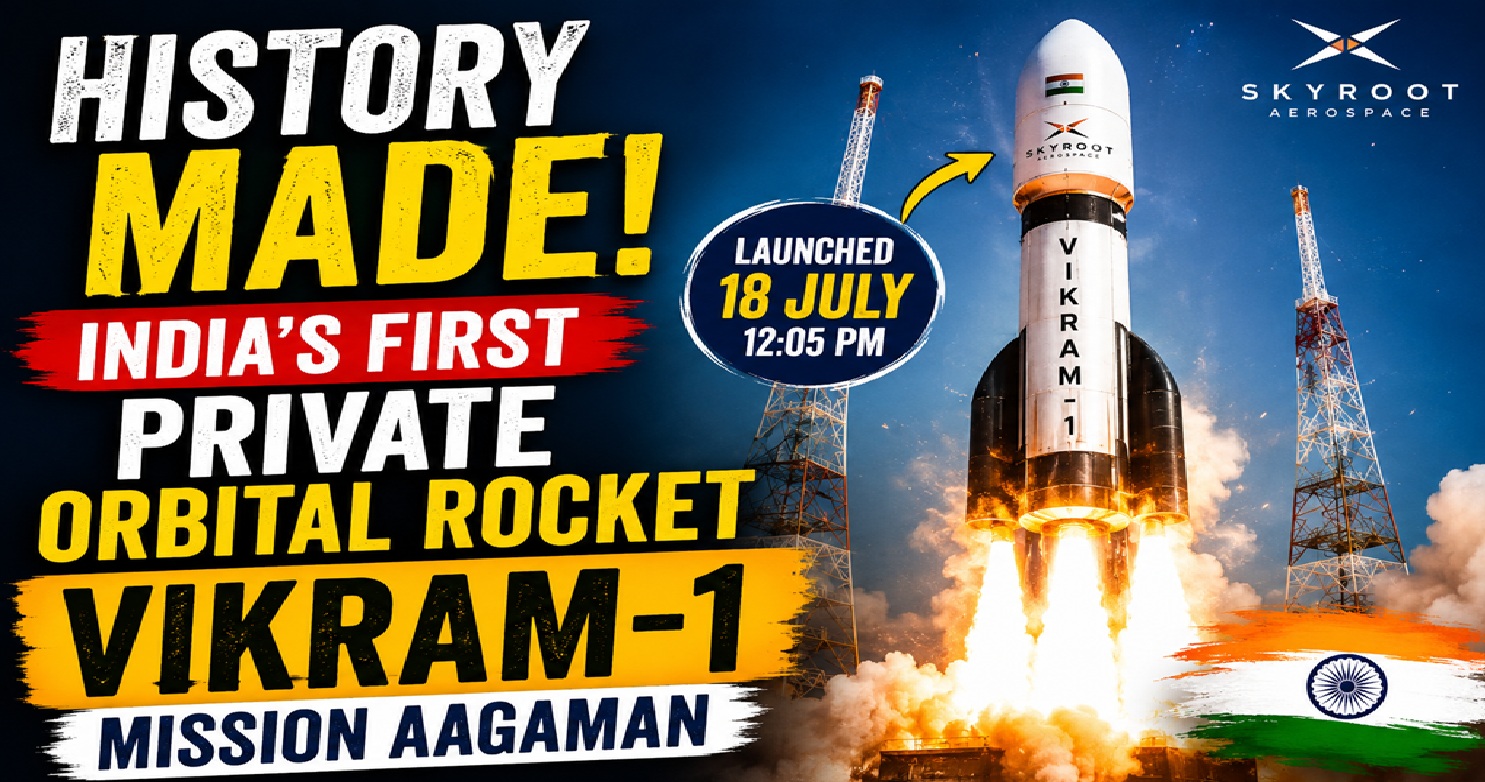
Skyroot’s Vikram-1 ‘Mission Aagaman’: India’s First Private Orbital Rocket Opens a New Era in Space Innovation
Skyroot’s Vikram-1 ‘Mission Aagaman’: India’s First Private Orbital Rocket Opens a New Era in Space Innovation
Skyroot’s Vikram-1 ‘Mission Aagaman’: Skyroot Aerospace creates history with the successful launch of Vikram-1 under Mission Aagaman, making it India’s first privately built orbital rocket. Here’s why the mission is a game-changer for India’s space economy, commercial launch market, and future space ambitions.
Skyroot’s Vikram-1 ‘Mission Aagaman’: India’s First Private Orbital Rocket Opens a New Chapter in India’s Space Race
Amit Kaul – For Digital Desk, Bengaluru: July 18, 2026 – India’s space journey reached another defining milestone on July 18, when Skyroot Aerospace, the country’s first private space company, successfully launched Vikram-1, India’s first privately developed orbital launch vehicle. The historic mission, appropriately dubbed Mission Aagaman (Arrival), represents much more than just a rocket’s successful launch; it also signifies the entry of India’s private space sector onto the international commercial launch arena.
Launched from the Satish Dhawan Space Centre in Sriharikota, Andhra Pradesh, the mission experienced a brief delay of around 35 minutes due to adverse weather conditions and navigation checks before lifting off successfully at 12:05 PM.
For India, this achievement is comparable to the liberalization of the telecom and aviation sectors decades ago. The nation’s space ecosystem is no longer solely driven by government agencies; private innovation has officially entered orbit.
Why Vikram-1 Matters More Than Just Another Rocket Launch
India has launched hundreds of satellites over the past several decades through ISRO, earning global recognition for cost-effective space missions.
However, Vikram-1 represents something fundamentally different.
This is India’s first orbital rocket designed, manufactured, tested, and launched by a private company.
That distinction changes the country’s commercial space narrative.
Instead of depending entirely on government-led launches, India now possesses the capability to allow private companies to design launch vehicles for global customers—a market projected to grow into hundreds of billions of dollars over the coming decade.
Mission Aagaman therefore represents the beginning of India’s transition from being a government-dominated space nation to becoming a competitive commercial space economy.
https://aamnewsnetwork.com/india-brahmos-missile-china-fujian-aircraft-carrier-analysis/
Skyroot’s Vikram-1 ‘Mission Aagaman’: Engineering Behind Vikram-1
One of the most remarkable aspects of Vikram-1 is its lightweight construction.
Unlike conventional metallic launch vehicles, Vikram-1 has been built using an advanced carbon-composite structure, making it India’s first orbital rocket to adopt this technology extensively.
Carbon composites provide multiple engineering advantages:
- Nearly five times lighter than steel
- Higher structural strength
- Reduced launch mass
- Better fuel efficiency
- Lower launch costs
Every kilogram saved on the rocket translates into more payload capacity or lower operational expenses—both critical factors in commercial launch competitiveness.
The rocket employs a three-stage solid propulsion system, followed by a liquid-fuel orbital adjustment module.
Each stage serves a distinct role:
- The first three solid-fuel stages generate the enormous thrust needed to escape Earth’s gravity.
- After reaching space, the liquid propulsion module performs precise orbital insertion, ensuring satellites are placed accurately into their intended trajectories.
- This combination provides reliability while maintaining cost efficiency.
Mission Aagaman: More Than a Technology Demonstration
Skyroot named the inaugural orbital mission Mission Aagaman, symbolizing the arrival of a new era for India’s private space ecosystem.
The rocket is designed to deploy payloads into a 450 km circular Low Earth Orbit (LEO) with an inclination of 60 degrees.
This orbit is strategically significant.
Low Earth Orbit hosts:
- Earth observation satellites
- Weather monitoring satellites
- Scientific research missions
- Communication constellations
- Technology demonstration spacecraft
It is also similar to the orbital altitude used by many global commercial satellite operators, making Vikram-1 particularly attractive for international customers.
Skyroot’s Vikram-1 ‘Mission Aagaman’: A Diverse Payload Reflecting India’s Growing Space Ecosystem
Mission Aagaman carried multiple domestic and international payloads, highlighting the growing diversity of India’s commercial space sector.
Among them were:
- Technology demonstration payload from Graha Space
- Payload from Cosmoserv Space
- Research payload developed by D-Cubed
- Skyroot’s own in-house Scope payload
An artistic creation was possibly Vikram-1’s most distinctive payload.
The mission carried Cosmos Diamonds’ “Cosmic Bloom,” a micro-art masterpiece featuring a miniature 18-carat gold rocket engraved with tiny sculptures of three iconic Indian scientists:
- Sir C.V. Raman
- Dr. Vikram Sarabhai
- Dr. A.P.J. Abdul Kalam
This symbolic payload merged science, engineering, history, and art—demonstrating that space missions increasingly carry cultural significance alongside technological objectives.
From Vikram-S to Vikram-1: A Remarkable Journey
Skyroot’s achievement did not happen overnight.
In 2022, the company successfully launched Vikram-S, India’s first privately built suborbital rocket.
That mission reached an altitude of approximately 89.5 kilometres, validating critical propulsion, avionics, and launch systems.
Vikram-1 represents the natural evolution of that success.
Unlike a suborbital mission, an orbital launch requires the rocket to achieve significantly higher velocity—around 7.8 kilometres per second—to remain in Earth’s orbit.
Crossing that technological threshold places Skyroot among a relatively small group of private launch providers worldwide capable of reaching orbit.
Skyroot’s Vikram-1 ‘Mission Aagaman’: The Economic Significance for India
The timing of Mission Aagaman aligns with India’s broader ambition to expand its presence in the global space economy.
Worldwide demand for launching small satellites is increasing rapidly due to:
- Earth observation
- Climate monitoring
- Internet satellite constellations
- Defence applications
- Scientific research
- Agriculture technology
Small satellite launches are expected to dominate the commercial launch market during the coming decade.
Private Indian companies like Skyroot could become major players by offering cost-effective launch services from Indian launch facilities.
Beyond launches, the mission is expected to generate opportunities across:
- Advanced manufacturing
- Composite materials
- Artificial intelligence
- Satellite engineering
- Space electronics
- Aerospace employment
The success of Vikram-1 also validates India’s space-sector reforms, which have encouraged private participation while leveraging ISRO’s decades of expertise.
India’s Expanding Space Ambitions
Mission Aagaman comes at a time when India’s space ambitions are accelerating on multiple fronts.
Following the success of Chandrayaan-3 and Aditya-L1, the country is preparing for ambitious programmes including:
- Gaganyaan human spaceflight
- Space station development
- Expanded lunar exploration
- Deep-space missions
- Commercial satellite launch expansion
Private companies will increasingly complement government-led missions by delivering faster innovation cycles, specialized technologies, and competitive commercial services.
Skyroot’s success demonstrates that India’s future in space will likely be built through collaboration between ISRO and a vibrant private aerospace ecosystem.
The Bigger Picture
Mission Aagaman is not merely the story of a successful rocket launch—it is the story ofIndia’s changinginnovationlandscape.
A startup founded less than a decade ago has achieved what once required decades of institutional infrastructure.
By successfully placing a privately built orbital rocket into space, Skyroot Aerospace has proven that Indian startups can compete in one of the world’s most technologically demanding industries.
https://digitalamitkaul.online/drdo-missile-test-notam-abdul-kalam-island-bay-of-bengal-2026/
As commercial space becomes the next frontier of global economic competition, Vikram-1 positions India not merely as a participant but as an emerging launch destination for the world.
The countdown that briefly paused before liftoff may have delayed Mission Aagaman by just 35 minutes, but its successful launch has accelerated India’s private space ambitions by years. For the country’s aerospace sector, this was more than an arrival—it was the beginning of an entirely new orbit of opportunity.
Author Bio:
Amit Kaul is a seasoned journalist and digital content strategist with over a decade of experience covering business, technology, finance, and digital economy trends. Based in Bengaluru, India, he specializes in producing high-quality, data-driven news articles optimized for global audiences and digital platforms. Amit is passionate about financial inclusion, fintech innovations, and economic developments that shape India and the world. His work has been featured on multiple news portals and Google News platforms, providing readers with timely and reliable insights.



Pingback: Vikram-1 Reaches Orbit: India's First Private Rocket Marks a Historic Leap in Space Innovation - DNN