
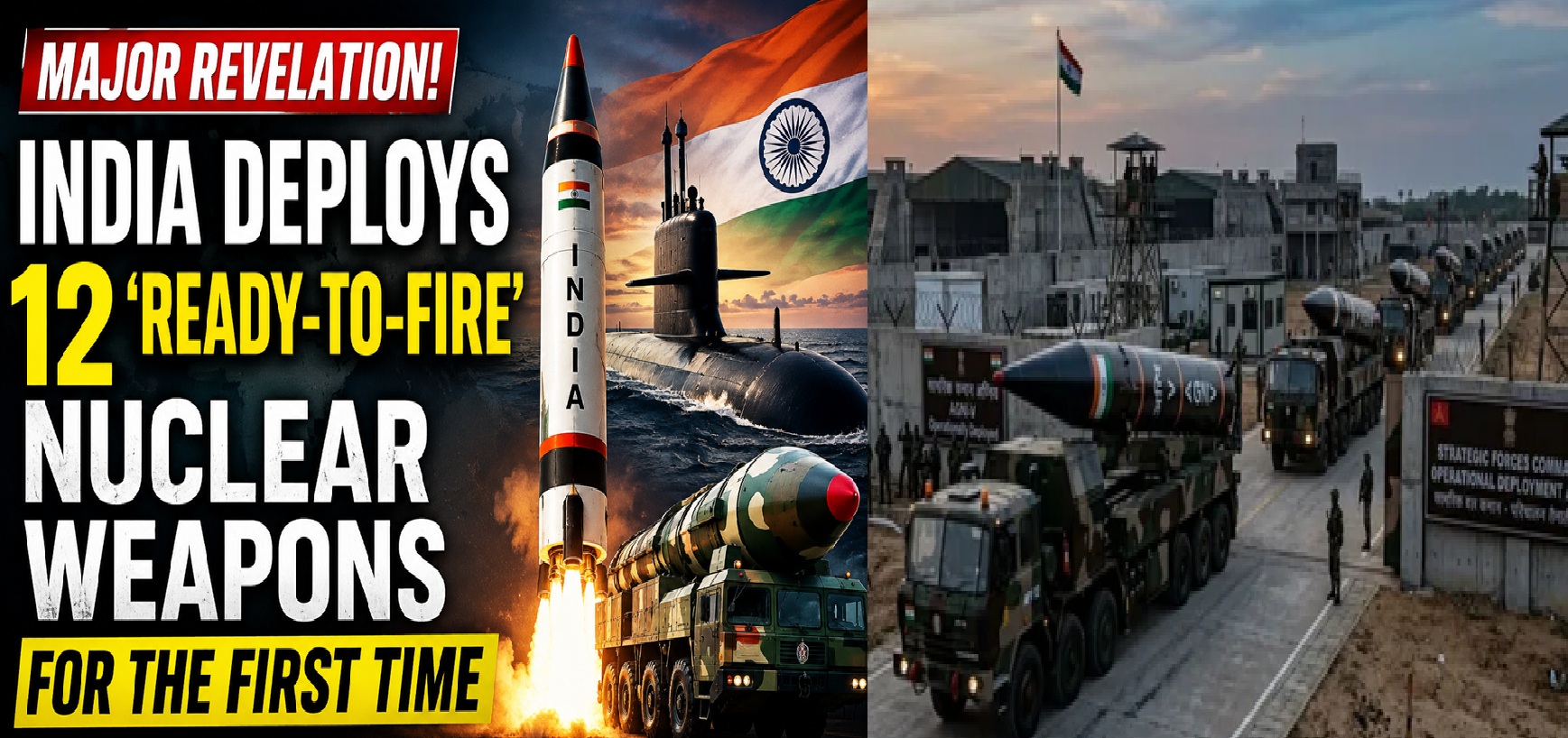
Major Revelation: India Deploys 12 ‘Ready-to-Fire’ Nuclear Weapons for the First Time — What It Means for South Asia’s Strategic Balance
Major Revelation: India Deploys 12 ‘Ready-to-Fire’ Nuclear Weapons for the First Time — What It Means for South Asia’s Strategic Balance
Major Revelation: A new SIPRI report suggests India has operationally deployed 12 nuclear warheads for the first time, signaling a major shift in nuclear readiness. Explore the implications for India’s nuclear doctrine, regional security, and strategic deterrence.
Major Revelation: India Deploys 12 ‘Ready-to-Fire’ Nuclear Weapons for the First Time
Amit Kaul – For Digital Desk, Bengaluru: June 9, 2026 – A significant development in India’s nuclear posture has drawn international attention after a recent report by the Stockholm International Peace Research Institute (SIPRI) indicated that India may have deployed 12 nuclear warheads in an operationally ready configuration for the first time. If confirmed, the move would represent one of the most consequential shifts in India’s nuclear strategy since it declared itself a nuclear weapons state in 1998.
The report suggests that India is gradually transitioning from a traditionally recessed deterrence posture toward a higher level of operational readiness. While the development does not necessarily indicate an aggressive shift in doctrine, it highlights the evolving security environment in Asia and India’s efforts to strengthen the credibility of its nuclear deterrent.
https://aamnewsnetwork.com/india-indigenous-5th-generation-stealth-fighter-amca-private-companies/
What Does the SIPRI Report Say?
According to SIPRI’s latest assessment of global nuclear forces, India is estimated to possess approximately 190 nuclear warheads as of January 2026. This marks a modest increase compared to previous years and reflects India’s ongoing modernization of its strategic arsenal.
The most notable aspect of the report is the claim that around 12 nuclear warheads may now be considered “operationally deployed.” In nuclear terminology, operational deployment generally means that warheads are either mated to delivery systems or positioned alongside launch platforms in a manner that allows rapid use if required.
For decades, India’s nuclear strategy has been characterized by the separation of warheads and delivery systems during peacetime. This arrangement was designed to minimize risks of accidental launches, maintain political control over nuclear weapons, and reinforce India’s image as a responsible nuclear power.
The latest assessment suggests that some of these longstanding practices may be evolving.
Major Revelation: A Departure from India’s Traditional Nuclear Posture
Since conducting nuclear tests in 1998, India has maintained what analysts describe as a “credible minimum deterrence” strategy. Unlike major nuclear powers that maintain large numbers of weapons on high alert, India’s doctrine has traditionally emphasized restraint.
A core feature of this approach has been the deliberate separation of warheads from missiles and aircraft. Under this system, nuclear weapons could be assembled and activated only after receiving political authorization during a crisis.
The reported deployment of 12 operationally ready warheads, therefore, represents a potentially important shift. It suggests that India may be seeking to reduce response times and improve the survivability of its deterrent forces.
Defense experts argue that advances in missile technology, growing regional military competition, and concerns over strategic stability may be influencing this evolution.
Major Revelation: The Role of India’s Nuclear Triad
India’s nuclear deterrent is built around a nuclear triad consisting of land-based missiles, aircraft, and sea-based nuclear platforms.
The sea-based component has become increasingly important in recent years. Nuclear-powered ballistic missile submarines (SSBNs) provide what strategists call a “second-strike capability”—the ability to retaliate even after suffering a nuclear attack.
SIPRI’s report highlights India’s continued investment in this capability. The deployment of nuclear warheads aboard SSBNs and the conduct of deterrence patrols indicate a maturing sea-based deterrent.
For military planners, submarines offer a significant advantage because they are difficult to detect and destroy. This ensures that a retaliatory capability survives even in the event of a surprise attack, thereby strengthening deterrence.
The expansion of India’s sea-based nuclear force is widely viewed as one of the most important developments in the country’s strategic modernization efforts.
Major Revelation: Why Is India Increasing Nuclear Readiness?
Several factors may explain the apparent shift toward greater operational readiness.
First, the security landscape in the region has grown more complicated. India faces two nuclear-armed neighbors—Pakistan and China—both of which continue to modernize their strategic capabilities.
China’s rapid expansion of its missile forces, nuclear silos, and submarine fleet has attracted global attention. Meanwhile, Pakistan continues to develop tactical and strategic nuclear systems aimed at countering India’s conventional military superiority.
In such an environment, Indian policymakers may believe that a more responsive and survivable deterrent is necessary to maintain strategic balance.
Second, technological advancements, such as canisterized missile systems, allow nuclear weapons to be stored, transported, and launched more rapidly. These systems improve readiness while maintaining safety and security standards.
Third, sea-based deterrence naturally requires a certain degree of operational deployment because submarines conducting patrols must be capable of responding to threats if deterrence fails.
Does India’s No First Use Policy Change as a Result?
One of the key questions arising from the SIPRI report is whether greater operational readiness signals a change in India’s nuclear doctrine.
At present, there is no official indication that India has abandoned its “No First Use” (NFU) policy. Under this doctrine, India pledges not to initiate a nuclear strike and would use nuclear weapons only in retaliation for a nuclear attack against Indian territory or armed forces.
The reported deployment of operational warheads should therefore be viewed primarily through the lens of deterrence rather than offensive intent.
However, strategic analysts note that readiness levels and doctrinal commitments are separate issues. A country can maintain a No First Use policy while simultaneously improving the responsiveness and survivability of its nuclear forces.
In this context, the development appears to be more about strengthening deterrence credibility than altering the fundamental principles of India’s nuclear doctrine.
Major Revelation: Strategic Implications for South Asia
The implications of the reported deployment extend beyond India’s borders.
For Pakistan, increased Indian readiness may influence future military planning and deterrence calculations. For China, it signals India’s continued commitment to developing a robust and survivable nuclear force.
At the broader geopolitical level, the development reflects a global trend in which major powers are modernizing nuclear arsenals amid growing international tensions.
Whether India has formally changed its deployment policy or is simply adapting to new strategic realities, the SIPRI report underscores an important reality: nuclear deterrence remains central to national security calculations in the twenty-first century.
https://digitalamitkaul.online/drdo-missile-test-notam-abdul-kalam-island-bay-of-bengal-2026/
As India’s nuclear triad becomes more sophisticated and its sea-based deterrent matures, policymakers, military planners, and global observers will closely watch how the country balances strategic readiness with its long-standing commitment to responsible nuclear stewardship.
The deployment of 12 operationally ready nuclear warheads may represent only a small fraction of India’s estimated arsenal, but it could signal the beginning of a new phase in the country’s nuclear strategy—one defined by greater readiness, enhanced survivability, and a stronger emphasis on credible deterrence in an increasingly uncertain world.
Author Bio:
Amit Kaul is a seasoned journalist and digital content strategist with over a decade of experience covering business, technology, finance, and digital economy trends. Based in Bengaluru, India, he specializes in producing high-quality, data-driven news articles optimized for global audiences and digital platforms. Amit is passionate about financial inclusion, fintech innovations, and economic developments that shape India and the world. His work has been featured on multiple news portals and Google News platforms, providing readers with timely and reliable insights.


Pingback: Bengaluru-Ahmedabad IndiGo Flight Bomb Hoax Sparks Airport Panic: What Happened, Why It Matters, and How Aviation Security Responded - DNN
Pingback: Gujarat ATS Arrests Five More Suspected Jaish-e-Mohammed Operatives in Major Counter-Terror Crackdown - DNN
Pingback: NIA Exposes Terror's New Three-App Model: Instagram, Telegram & Crypto Fuel Digital Radicalization - ANN