
Major Security Breach Before PM Modi’s Bengaluru Visit: Explosive Material Found Near Event Venue Sparks Alarm
Major Security Breach Before PM Modi’s Bengaluru Visit: Explosive Material Found Near Event Venue Sparks Alarm
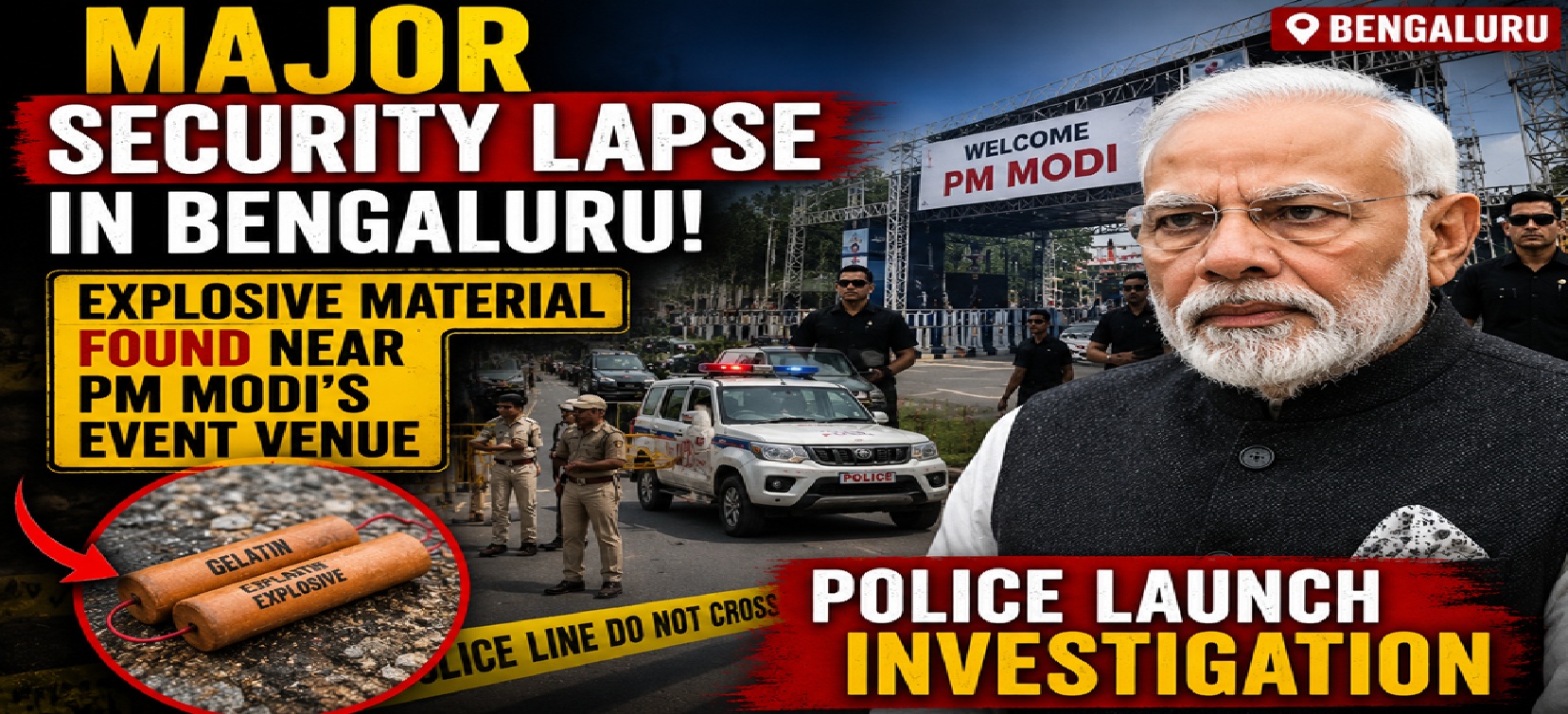
Major Security Breach Before PM Modi’s Bengaluru Visit: Two gelatin sticks were recovered near Prime Minister Narendra Modi’s Bengaluru event venue ahead of his visit, triggering a major security scare. Here’s an in-depth analysis of the security lapse, terror threat concerns, and implications for India’s VIP protection framework.
Amit Kaul – For Digital Desk, Bengaluru: May 10, 2026 – A significant security scare unfolded in Bengaluru on Sunday after explosive material was discovered near the venue of Prime Minister Narendra Modi’s scheduled public event. The recovery of two gelatin sticks roughly three kilometers from the main venue has raised serious questions about VIP security preparedness, intelligence coordination, and the broader threat environment facing India’s high-profile political leadership.
The discovery comes at a particularly sensitive time, with intelligence agencies already operating under heightened alert following recent terror-related inputs warning of potential attacks in major urban centers, including Delhi.
While authorities have not yet confirmed any direct terror link, the incident has immediately triggered alarm across national security and law enforcement agencies.
https://aamnewsnetwork.com/bjp-historic-win-west-bengal-election-2026-modi-analysis/
Major Security Breach Before PM Modi’s Bengaluru Visit: Explosives Found During Routine Security Sweep
According to senior police officials, the explosive material was detected during a routine anti-sabotage inspection conducted ahead of the Prime Minister’s arrival.
Officials from the Central Range police confirmed that two gelatin sticks were found lying along a footpath approximately three kilometers from the primary event venue. Bomb disposal units and forensic teams were immediately deployed to secure the area and begin preliminary analysis.
The discovery has intensified scrutiny of the security grid established for the Prime Minister’s visit, particularly because locations associated with VIP movement are typically subjected to multiple layers of sanitization and surveillance before any public appearance.
Security personnel routinely conduct route mapping, explosive-detection checks, drone-surveillance assessments, and crowd-control rehearsals during visits involving the Prime Minister. The fact that explosive material was still found within the broader security perimeter has therefore become a matter of serious institutional concern.
Why Gelatin Sticks Matter
Gelatin sticks are commonly used in mining, quarrying, and controlled blasting operations. However, they can also be repurposed for improvised explosive devices (IEDs), making their unauthorized presence near a high-security political event highly alarming.
Security experts note that gelatin sticks by themselves do not automatically indicate a sophisticated terror conspiracy. Yet their discovery near a Prime Ministerial event cannot be treated as accidental or routine negligence until investigations conclusively establish the source and intent behind their presence.
Investigators are currently examining several critical questions:
- Were the gelatin sticks intentionally placed near the route or venue?
- Did local criminal networks or illegal quarrying operators play any role?
- Was the material linked to reconnaissance activity?
- Could the incident have been a diversionary tactic intended to test security preparedness?
- These questions are now central to the ongoing police and intelligence investigation.
Major Security Breach Before PM Modi’s Bengaluru Visit: Timing Raises Bigger Security Concerns
What has made the Bengaluru incident even more sensitive is its timing.
Just a day before the Prime Minister’s visit, intelligence agencies reportedly issued warnings regarding possible terror threats in major cities. Following those alerts, Delhi Police and central security agencies had already heightened surveillance in sensitive zones, transportation hubs, and public gathering locations.
Security forces were instructed to closely monitor suspicious activity, abandoned objects, and unattended vehicles.
Against this backdrop, the discovery of explosive material near the Prime Minister’s event venue has naturally amplified concerns within India’s security establishment.
Analysts point out that modern terror tactics often involve probing exercises—small-scale security breaches designed to evaluate police response times, perimeter vulnerabilities, and coordination gaps. Even if the Bengaluru incident ultimately proves unrelated to terrorism, the mere possibility of such a scenario demands rigorous investigation.
The Challenge of Securing Public Political Events
India’s Prime Minister remains one of the most heavily protected political leaders in the world, guarded by the elite Special Protection Group (SPG), supported by state police, intelligence agencies, and central paramilitary units.
Yet large-scale public events continue to present enormous logistical challenges.
Unlike controlled environments such as airports or secured government compounds, political rallies involve unpredictable variables: massive crowds, open-access public areas, roadside structures, drainage systems, temporary installations, and dynamic traffic conditions.
Bengaluru itself presents unique security complexities due to its dense urban layout, expanding suburban corridors, and high civilian movement.
Security planners must therefore create multi-layered protective zones extending far beyond the immediate venue. The fact that suspicious explosive material surfaced within that wider operational radius suggests that even advanced security protocols can face vulnerabilities in high-density urban settings.
Major Security Breach Before PM Modi’s Bengaluru Visit: Political and Administrative Implications
The incident is likely to trigger a detailed review of standard operating procedures related to VVIP visits.
Questions may emerge regarding:
- The efficiency of pre-event sanitization drives
- Coordination between local police and intelligence units
- Monitoring of explosive materials in nearby industrial or construction zones
Surveillance coverage around event perimeters
Opposition parties and political commentators may also use the incident to question the effectiveness of current security management systems, particularly given the heightened national security environment.
At the same time, officials have cautioned against premature conclusions before forensic and investigative findings are completed.
Investigation Underway
Police have now launched a full-scale investigation into the origin of the gelatin sticks.
Forensic experts are expected to examine:
- Manufacturing details
- Possible fingerprints or residue
- Whether detonators were connected
- Transportation patterns in nearby areas
- CCTV footage from adjoining roads and commercial establishments
Authorities are also likely to investigate whether the explosive material was stolen from licensed industrial operations or illegally transported through informal networks.
Security around the Prime Minister’s remaining engagements has reportedly been intensified, with additional deployment of anti-sabotage teams and surveillance personnel.
Major Security Breach Before PM Modi’s Bengaluru Visit: A Wake-Up Call for Urban Security
Regardless of the investigation’s outcome, the Bengaluru incident underscores the evolving complexity of urban security threats in India.
Modern security challenges are no longer limited to direct attacks. Even suspicious objects or seemingly isolated discoveries can trigger widespread panic, disrupt governance, and expose operational weaknesses.
For intelligence agencies and law enforcement authorities, the discovery of explosive material near a Prime Ministerial event serves as a stark reminder that security preparedness must remain adaptive, decentralized, and constantly vigilant.
In a rapidly changing threat environment, even small lapses can carry national-level consequences.
Author Bio:
Amit Kaul is a seasoned journalist and digital content strategist with over a decade of experience covering business, technology, finance, and digital economy trends. Based in Bengaluru, India, he specializes in producing high-quality, data-driven news articles optimized for global audiences and digital platforms. Amit is passionate about financial inclusion, fintech innovations, and economic developments that shape India and the world. His work has been featured on multiple news portals and Google News platforms, providing readers with timely and reliable insights.


Pingback: PM Modi at Somnath Amrit Mahotsav: ‘Development and Heritage Must Progress Together’ - DNN
Pingback: PM Modi Shrinks Official Convoy to Just Two Vehicles Amid Fuel Conservation Push - ANN
Pingback: PM Modi Holds Exclusive Meeting with Sergey Lavrov at BRICS Summit; Doval-Araghchi Talks Signal India’s Expanding Diplomatic Role - DNN